

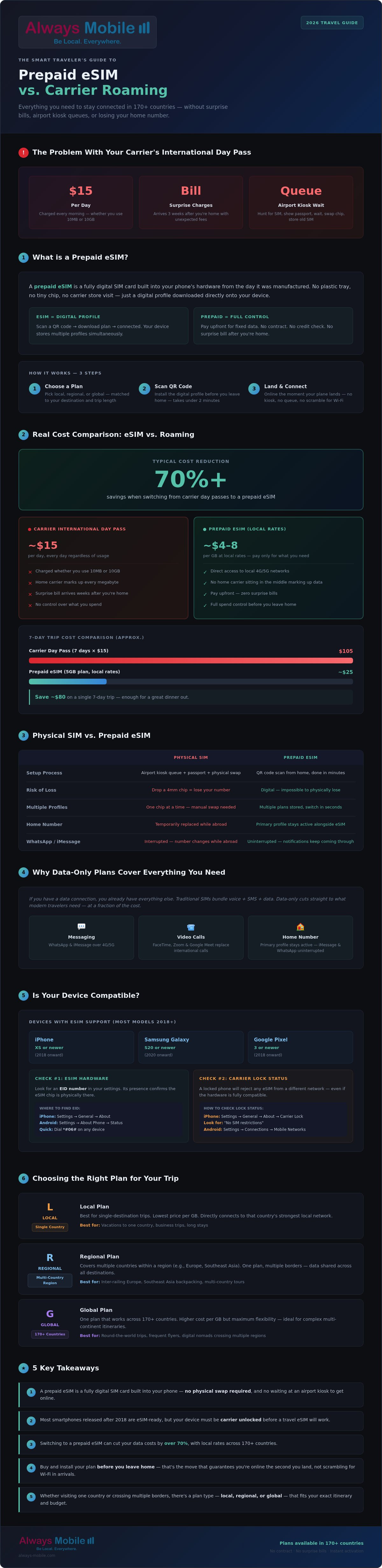
Your carrier's international day pass is not the safe option. It's a daily fee that quietly drains your travel budget every single morning, whether you use 10MB or 10GB. There's a smarter way to stay connected abroad, and it starts with a prepaid eSIM.
You already know the frustration. You land, your phone lights up with a "Welcome to [Country]" text, and suddenly you're doing mental math on roaming charges. You don't want to hunt for a SIM card kiosk, you don't want surprise charges on your next bill, and you definitely don't want to miss a WhatsApp message from home because you switched numbers.
This 2026 guide solves all of that. You'll learn exactly how prepaid eSIM technology works, why it's the cleanest way to separate your home identity from your travel connectivity, and how to get online the moment your plane lands in any of 170+ countries. From choosing between local, regional, and global plans to keeping your primary number active for iMessage and WhatsApp, everything you need is right here.
Key Takeaways
- A prepaid eSIM is a fully digital SIM card built into your phone — no physical swap required, and no waiting at an airport kiosk to get online.
- Most smartphones released after 2018 are eSIM-ready, but your device must be carrier unlocked before a travel eSIM will work.
- Switching to a prepaid eSIM instead of your carrier's international day pass can cut your data costs by over 70%, with local rates across 170+ countries.
- Buy and install your plan before you leave home — that's the move that guarantees you're online the second you land, not scrambling for Wi-Fi in arrivals.
- Whether you're visiting one country or crossing multiple borders, there's a plan type — local, regional, or global — that fits your exact itinerary and budget.
What is a Prepaid eSIM and How Does it Work?
Think of a prepaid eSIM as a SIM card that lives inside your phone's hardware from the day it was manufactured. There's no plastic tray, no tiny chip to handle, and no carrier store visit required. Instead of a physical card, your data plan is a digital profile downloaded directly onto your device. Pick a plan, scan a QR code, and you're connected. That's the entire process.
The "prepaid" part is just as important as the "eSIM" part. You pay upfront for a fixed amount of data, and when it's gone, you top up or you don't. No contract. No credit check. No bill arriving three weeks after you're home with charges you didn't expect. You're in complete control of what you spend before you spend it.
The End of the Physical SIM Era
Physical SIMs had one fundamental problem: they were physical. You'd land in a new country, join a queue at a kiosk, hand over your passport, wait, and eventually swap out your home SIM for a local one, which then had to be stored somewhere safe for the return flight. Lose it, and you'd lost your number.
A prepaid eSIM eliminates every step of that process. Your device can store multiple digital profiles simultaneously, so switching between a local plan and your home carrier profile takes seconds. No paperclip. No tray. No risk of dropping a 4mm chip into an airport drain.
Data-Only eSIMs vs. Traditional SIMs
Traditional SIMs bundle voice minutes, SMS, and data together because that's how mobile networks were built. You paid for all three, whether you used them or not. Data-only plans cut straight to what modern travelers actually need.
Here's the reality: if you have a data connection, you already have everything else.
- WhatsApp and iMessage handle all your messaging and calls over 4G or 5G.
- FaceTime, Zoom, and Google Meet replace international voice calls entirely.
- Your home number stays active on your primary profile, so iMessage and WhatsApp notifications keep coming through without interruption.
Because data-only plans don't carry the overhead of voice and SMS infrastructure, they're significantly cheaper than traditional roaming SIMs. You're accessing local 4G and 5G networks directly, at local rates, without your home carrier sitting in the middle and marking up every megabyte. That's the core reason a prepaid eSIM consistently undercuts international day passes on cost. You can explore available plans across 170+ destinations at Always Mobile's Prepaid eSIM for International travel to see exactly what local rates look like for your next trip.
Is Your Device Ready? Compatibility and Setup
Before you browse a single plan, you need to answer one question: can your phone actually use a prepaid eSIM? The good news is that most modern smartphones can. The potential snag is a network lock that has nothing to do with the hardware itself. Here's how to check both in under five minutes.
How to Check Your Phone's eSIM Status
eSIM support became standard across flagship devices starting around 2018. If you're carrying an iPhone XS or newer, a Samsung Galaxy S20 or newer, or a Google Pixel 3 or newer, you're almost certainly working with eSIM-capable hardware. The fastest way to confirm it is to look for an EID number buried in your settings. An EID (Embedded Identity Document) is your device's unique digital ID, and its presence confirms the eSIM chip is physically there.
Find yours in seconds:
- iPhone: Go to Settings → General → About. Scroll down until you see "EID." If it's there, you're eSIM-ready.
- Android (Samsung, Pixel, and most others): Go to Settings → About Phone → Status Information. Look for "EID" in that list.
- Quick shortcut: Dial *#06# on any device. Your IMEI numbers and EID will display on screen instantly.
No EID visible? Your device either doesn't support eSIM, or it's an older model that predates the technology. Check your device compatibility here to confirm before purchasing any plan.
Understanding Network Locks
A carrier lock is a software restriction your home carrier installs to keep your phone tied to their network. It has nothing to do with your hardware's capabilities. A locked phone will reject any eSIM profile from a different network, including a travel eSIM, no matter how compatible the device itself is.
Checking your lock status is straightforward. On iPhone, go to Settings → General → About and look for "Carrier Lock." If it reads "No SIM restrictions," you're free. Android users can usually find this under Settings → Connections → Mobile Networks, though the exact path varies by manufacturer.
If your phone is locked, contact your home carrier directly before your trip. Most carriers will unlock a device that's paid off and in good standing, often within 24 to 72 hours of a simple request. Don't leave this until the night before you fly.
One clarification worth making: a prepaid phone isn't automatically a locked phone. "Prepaid" describes how you pay for service, not how your hardware is restricted. Many prepaid devices are fully unlocked and work with any eSIM profile without issue.
Once you've confirmed your EID and cleared any carrier lock, you're set. Installing a prepaid eSIM then comes down to scanning a QR code, which takes about 60 seconds. Browse compatible plans for your destination once your device is confirmed ready to go.
Prepaid eSIM vs. Roaming: The Real Cost Comparison
Your carrier's international day pass sounds reasonable until you do the actual math. A two-week trip at $10 per day is $140 spent purely on the privilege of using data you already pay for at home. That's before you factor in what "unlimited" actually means in the fine print.
The Hidden Trap of "Daily Passes"
The word "unlimited" is doing a lot of heavy lifting in carrier roaming marketing. Read the terms and you'll find a data threshold, often as low as 512MB or 1GB, after which speeds drop to 2G. That's slow enough to make Google Maps fail to load, let alone stream anything or make a video call. You're paying full price for a service that becomes functionally useless by mid-afternoon on a busy travel day.
The cumulative cost is the other problem nobody talks about. Day passes charge you automatically, every morning, whether you're on a 14-hour flight, spending the day at a beach with no signal, or just sleeping in. There's no pause button. A 14-day trip locks you into 14 charges regardless of actual usage. That's the model working exactly as designed, for the carrier, not for you. For a deeper breakdown of how these costs stack up side by side, this comparison of prepaid eSIM vs. roaming covers the numbers in full detail.
Background data roaming is a quieter version of the same problem. Apps refreshing in the background, push notifications, automatic updates — all of it can trigger roaming charges before you've even unlocked your screen after landing. With a prepaid eSIM, you've already paid for your data upfront. There's no meter running, no surprise line item three weeks later.
Local 5G Access for Local Prices
A prepaid eSIM connects you directly to local carrier towers in your destination country. No home carrier sitting in the middle. No markup on every megabyte. You're getting the same 4G and 5G speeds that residents pay local rates for, which is exactly why the savings are so significant compared to roaming.
For single-country trips, a local plan is the cleanest option. You pick the destination, select the data amount you need, and you're connected at local network priority. No throttling thresholds buried in terms and conditions. Browse local plans by destination to see what's available for your specific trip.
The strategy here is straightforward: keep your home SIM active for iMessage, WhatsApp, and calls, and run your travel data through a local eSIM plan. Two profiles, one phone, zero roaming charges. That's the traveler advantage carriers don't advertise.
Step-by-Step: Staying Connected While You Travel
The setup process for a prepaid eSIM takes less than five minutes. The mistake most travelers make isn't technical — it's timing. Waiting until you land to figure this out puts you at the mercy of airport Wi-Fi, which is exactly the wrong environment for a first-time activation. Here's the sequence that works every time.
The "Buy Before You Fly" Strategy
Purchase your plan at home, on your own Wi-Fi, before you pack your bag. Airport networks are congested, inconsistent, and occasionally blocked in ways that interfere with QR code scanning and profile downloads. Your home connection removes all of that friction.
Once you've selected your plan, the installation process is straightforward:
- Open your phone's camera and point it at the QR code provided after purchase.
- Tap the prompt that appears to add a new cellular plan.
- Follow the on-screen steps to confirm the installation. The profile downloads in under 30 seconds on a stable connection.
- Label the new line "Travel" in your phone's cellular settings. This keeps your dual-SIM setup clean and prevents confusion about which line is active at any point in the trip.
One critical step after installation: do not turn on data roaming for the eSIM line yet. Leave it off until you land. Once you arrive at your destination, switch data roaming on for the Travel line only, and confirm your primary SIM's data roaming is turned off. That single setting prevents your home carrier from running a background meter you never authorized.
How to Keep Your WhatsApp Number
This is where most guides go silent, and it's the detail that matters most to travelers. When you activate a new eSIM line, WhatsApp may prompt you to update your registered number. Do not do this. Tap "Not now" or dismiss the prompt entirely. Your WhatsApp account is tied to your home number, and changing it mid-trip means losing your chat history, your contacts' ability to reach you, and your group memberships.
The same logic applies to iMessage. As long as your home SIM remains active in the background, iMessage continues routing through your existing Apple ID and phone number without any changes on your end. You don't need to reconfigure anything. Data flows through your travel eSIM; your identity stays anchored to your home number.
Managing the dual-SIM split correctly looks like this:
- Default data line: Set to your Travel eSIM.
- Primary calls and SMS: Set to your home SIM.
- Data roaming on home SIM: Off. Always off while abroad.
- Data roaming on Travel eSIM: On, once you've landed.
That configuration gives you local data speeds, zero roaming charges on your home bill, and an uninterrupted WhatsApp and iMessage experience on the number everyone already has for you. No compromises, no workarounds.
Ready to set this up for your next trip? Browse Always Mobile's plans for your destination and get your eSIM installed before you leave home.
Choosing the Right Prepaid Plan for Your Trip
Not every trip is the same, and neither is every plan. The right choice comes down to three variables: how many countries you're visiting, how long you'll be there, and how much data you actually need. Get this match right, and you'll never overpay for coverage you don't use or scramble for a top-up at the worst possible moment.
Here's how each plan type maps to a real travel scenario:
- **Local Plans ** are built for depth, not breadth. If you're spending two weeks in Thailand or a month exploring Spain, a local plan gives you the best possible rates on a single network. You're not paying for coverage across borders you'll never cross.
- **Regional Plans ** are the backpacker's best friend. Crossing from Portugal into Morocco, or hopping between Vietnam, Cambodia, and Laos? One regional plan covers the whole route. No new SIMs. No reconfiguring settings at each border.
- **Global Plans ** are for itineraries that span continents. Round-the-world trips, frequent business travelers, or anyone whose passport sees three or more regions in a single journey. One plan, one activation, everywhere.
- **Daily Unlimited Plans ** are purpose-built for power users. If you're working remotely, running video calls, or uploading content on the road, a daily unlimited plan gives you consistent 4G and 5G without watching your data balance shrink by the hour.
Multi-Country Freedom with Regional eSIMs
A regional prepaid eSIM is the cleanest solution for multi-stop itineraries. You cross a border, your phone connects to the local network automatically, and nothing changes on your end. No settings to update. No new QR code to scan. No kiosk to find in an unfamiliar arrivals hall.
Fixed-duration country passes from carriers like T-Mobile are US-only products. They offer zero flexibility for travelers moving across multiple countries, which is exactly the gap a regional plan fills. Explore multi-country regional plans to see which regions are covered and find the right fit for your route. For a deeper look at how local plans compare across individual destinations, The Ultimate Guide to Local eSIM Plans for International Travel in 2026 breaks it down country by country.
Always Mobile: Your Smarter Travel Companion
Always Mobile offers instant activation across 170+ countries, with high-speed local data and transparent pricing that shows you exactly what you're getting before you buy. No contracts. No hidden fees. No bill shock three weeks after you land back home.
Whether you need a single-country local plan, a regional pass for a multi-stop trip, or a daily unlimited option for remote work on the road, everything is in one place. See all global and get your eSIM set up before your next departure.
Your Next Trip Starts With One Smart Decision
Roaming charges, airport SIM kiosks, and surprise bills belong to a different era of travel. A prepaid eSIM replaces all of that with instant 4G and 5G connectivity, transparent upfront pricing, and zero fees waiting for you when you get home.
The setup takes minutes. The savings are immediate. And with coverage across 170+ countries, whether you're locked into one destination or crossing multiple borders, there's a plan that fits your exact trip. Local, regional, global, or daily unlimited — you pick what you need and pay for nothing more.
One device. Two profiles. Your home number stays active, your travel data runs on local rates, and you land already connected.
Don't leave this until you're standing in arrivals looking for Wi-Fi. Get your plan sorted before you fly. Browse Always Mobile's prepaid eSIM plans for 170+ countries and be online the moment your wheels touch down.
Frequently Asked Questions About Prepaid eSIMs for International Travel
How much does a prepaid eSIM cost for international travel?
Pricing varies by destination, data amount, and plan type, so there's no single universal figure. What's consistent is that a prepaid eSIM costs significantly less than a carrier's international day pass for most trips. Local plans for single-country travel tend to be the most affordable option, while regional and global plans cost more upfront but cover multiple countries without requiring separate purchases at each border.
The key advantage is predictability. You see the exact price before you buy, pay once, and that's it. No daily charges accumulating while you sleep, no bill arriving weeks later with surprises on it.
Can I keep my original phone number while using a travel eSIM?
Yes, and this is one of the most important things to understand before activating. Your home SIM stays installed and active in the background while your travel eSIM handles data. That means WhatsApp, iMessage, and standard calls continue routing through your original number without any changes on your end. Your contacts reach you exactly as they always have.
The only thing to avoid is accepting any prompt from WhatsApp to update your registered number after activation. Dismiss it immediately. Your account stays tied to your home number, and your chat history stays intact.
Does a prepaid eSIM work with any smartphone?
Not every smartphone, but most modern ones do. eSIM support is standard across iPhones from the XS onward, Samsung Galaxy devices from the S20 onward, and Google Pixel phones from the Pixel 3 onward. The hardware requirement is straightforward to check: look for an EID number in your device settings or dial *#06# to confirm it's there.
The second requirement is carrier unlocking. Your device needs to be free of network restrictions before a travel eSIM profile will install correctly. A locked phone will reject the profile regardless of hardware compatibility, so check your lock status before purchasing any plan.
Do I need to delete my eSIM after my trip is over?
You don't have to, but it's good practice to delete it once the data is fully used and you're home. Most devices support multiple stored eSIM profiles, so leaving an inactive travel profile in place won't cause problems. That said, keeping your cellular settings clean reduces confusion, especially if you travel frequently and install new plans regularly.
Deleting a profile is simple. Go to your cellular settings, select the travel line, and choose "Delete Plan." If you return to the same destination later, you'd purchase and install a new plan anyway, so there's no benefit to keeping an expired one around.
Can I use my prepaid eSIM for hotspot and tethering?
Hotspot/tethering is available on all Always Mobile prepaid eSIM plans for international travel. Tethering lets you share your data connection with a laptop or tablet. Tethering is very useful if you're working remotely and need to connect multiple devices.
Daily unlimited plans are typically the most practical option for heavy hotspot use. They give you consistent 4G and 5G without the anxiety of watching a fixed data balance drop every time you share your connection with another device.
What happens if I run out of data while abroad?
You top up. That's the entire process. Most providers let you purchase additional data directly through their app or website, and the new allocation activates immediately on the same eSIM profile. You don't need to reinstall anything or scan a new QR code.
The smarter move is to estimate your usage honestly before you leave. If you stream video, use navigation constantly, or work remotely, buy more data than you think you'll need. Unused data on a prepaid plan is a minor loss; running out mid-trip and scrambling for Wi-Fi is a much bigger inconvenience. Always Mobile's fixed-data esIM plans allow for top-ups. Our Daily Unlimited plans do not support top-ups.
Is a data-only eSIM enough for my travel needs?
For the vast majority of travelers, yes. A data connection gives you access to WhatsApp calls and messaging, FaceTime, Google Maps, translation apps, booking platforms, and every other tool you'd realistically use on a trip. Voice calls and SMS over a local number are rarely necessary when your home number stays active on your primary SIM for anything urgent.
The only scenario where a data-only plan falls short is if you need a local phone number in your destination country, for example, to receive verification texts from local services or businesses. For standard international travel, a data-only prepaid eSIM covers everything that matters.
How do I activate my eSIM if I don't have a QR code?
Some providers offer manual activation as an alternative. Instead of scanning a QR code, you enter an activation code, SM-DP+ address, and confirmation code directly into your device's cellular settings. On iPhone, this option appears under Settings, then Cellular, then Add eSIM, then Enter Details Manually. Android devices have a similar manual entry path, though the exact menu labels vary by manufacturer.
If your provider offers an app-based activation flow, that's often the simplest route. You log in, select your plan, and the profile installs directly without a QR code or manual entry. Check which activation method your provider supports before your trip so you're not troubleshooting it at the airport.