

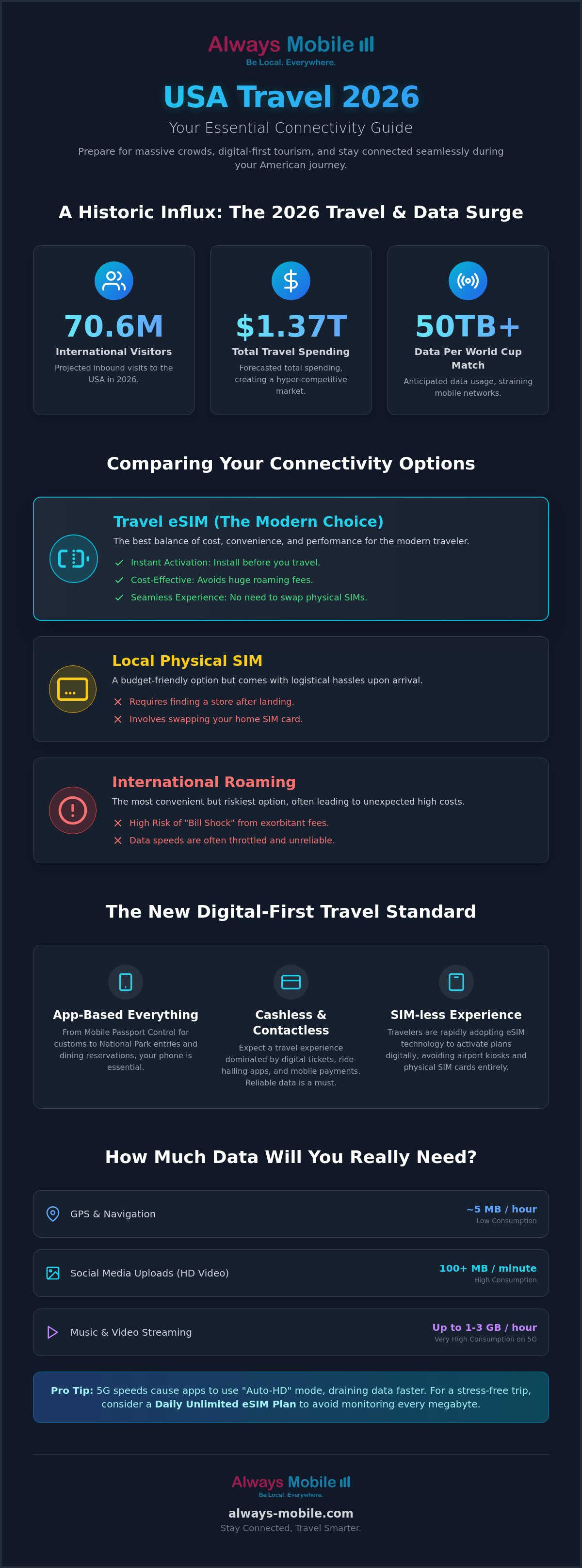
Verizon anticipates data usage at the 2026 World Cup will exceed 50 terabytes per match. That is a massive amount of digital traffic for any network to handle. If you are planning a trip to the States, securing reliable USA travel data is no longer a luxury. It is a fundamental utility for navigating massive crowds and complex city logistics. You shouldn't have to worry about 5G dead zones in rural areas or the "bill shock" that often follows international roaming.
We understand that you want to land, activate your connection, and immediately access your GPS or social media. It's stressful to guess whether your data will hold up in a packed stadium or a remote national park. This guide helps you navigate the 2026 travel landscape with total confidence. You will learn how to secure the most reliable, cost-effective mobile data for your American journey. We will break down the latest 2026 US travel trends and show you how high-speed eSIM plans provide a seamless, budget-friendly alternative to traditional roaming. Get ready to experience the United States without the connectivity headaches.
Key Takeaways
- Prepare for the 2026 World Cup by understanding how massive events impact network congestion and mobile reliability in host cities.
- Calculate your specific USA travel data requirements to ensure you have enough bandwidth for GPS and social media without overpaying.
- Identify why traditional international roaming leads to "bill shock" and how to bypass these hidden costs with modern eSIM technology.
- Secure instant connectivity before you even clear customs with a digital activation process that eliminates the need for physical SIM cards.
- Compare local US plans and global eSIM options to find the perfect balance of coverage and speed for your American journey.
Table of Contents
-
Personal USA Travel Data: Calculating Your Connectivity Needs
-
Comparing Connectivity Options: Roaming vs. Local SIM vs. eSIM
-
The 2026 World Cup and Major Events: Connectivity Challenges
The Landscape of USA Travel in 2026: Key Trends and Stats
The United States is bracing for a historic surge in tourism. According to the U.S. Travel Association, inbound international visits are expected to reach 70.6 million in 2026. This represents a 3.4% increase from previous years. While demand remains resilient, geopolitical factors and shifting economic climates are changing how visitors approach their journeys. Total travel spending is forecasted to hit a staggering $1.37 trillion. For the individual traveler, these numbers mean one thing: competition for resources. Managing your USA travel data effectively is no longer just about convenience. It's a strategic move to ensure you can navigate crowded hubs and secure reservations in a hyper-competitive market.
Projected Traveler Volume and Economic Factors
Travel spending growth is projected at 1% inflation-adjusted in 2026. This figure highlights the significant impact of the Travel Price Index (TPI) on your vacation budget. The TPI tracks the costs of travel-related goods and services, and it's currently driving many visitors toward budget-friendly digital solutions. You'll likely see higher prices for traditional services like hotels and guided tours. Smart travelers are offsetting these costs by cutting out expensive legacy expenses. 2026 is a milestone year for US international arrivals. To handle this influx, the American tourism sector has shifted toward a digital-first model. Carriers are aggressively expanding 5G infrastructure to support the millions of devices hitting the network simultaneously. You need a connection that can keep up with this modern pace.
The Shift Toward Contactless and Data-Heavy Tourism
Digital connectivity is now a mandatory requirement for entering the country. The rise of Mobile Passport Control (MPC) has made app-based entry the standard for clearing customs efficiently. You'll also find that apps are required for everything from National Park entries to basic dining reservations. Prepare for a cashless and SIM-less experience. Many travelers are abandoning physical chips and adopting eSIM technology to stay connected. This transition removes the friction of finding a physical kiosk at the airport. You can activate your plan before you leave home. Reliable data ensures you can manage your digital tickets, ride-hailing apps, and real-time navigation without interruption. Check out our all plans by destination to see how you can secure your connection today. Don't wait until you land to realize you're disconnected in a country that increasingly lives on the cloud.
Personal USA Travel Data: Calculating Your Connectivity Needs
Industry reports often focus on massive figures like the $12 billion global eSIM market. For you, USA travel data is much more granular. It's about having enough bandwidth to call an Uber at 2 AM in New York City or look up a restaurant in downtown Chicago. Industry "big data" measures infrastructure. Your personal data allowance measures your freedom. Don't let technical jargon distract you from your specific needs. You need a plan that matches your itinerary, not a generic corporate statistic.
A typical 2-week US road trip in 2026 requires more data than you might expect. Between streaming music for long drives and using real-time navigation, consumption adds up quickly. 5G speeds are now the standard across most major American highways. These high speeds often trigger apps to stream in "Auto-HD" mode. This means your phone consumes more data per minute than it would on a slower 4G network. This drains your USA travel data faster than you're likely used to at home. You need a plan that accounts for this increased appetite.
Estimating Your Gigabyte (GB) Requirements
Google Maps is surprisingly efficient, using roughly 5 MB for every hour of active navigation. However, social media is where your data disappears. Uploading a high-definition video at a landmark like the Grand Canyon can consume 100 MB in seconds. If you plan to share your journey in real-time, 1 GB or 2 GB plans won't last. Many 2026 travelers are choosing Daily Unlimited eSIM Plans to avoid the stress of counting megabytes. It's the simplest way to ensure you never lose access to your essential travel tools.
Managing Background Data and Roaming Traps
Identify data-hungry apps before you leave home. Check your settings to see which apps are using the most background data. Cloud backups and automatic app updates are common roaming traps that can drain your balance in hours. Turn these off in your cellular settings. It's also vital to set up data alerts on compatible devices to stay informed. Mapping your itinerary against carrier coverage maps is also a smart move. While urban areas have excellent 5G, some rural parks still rely on LTE. If you're heading off the beaten path, consider a local eSIM solution that offers priority access to the strongest available network.
Comparing Connectivity Options: Roaming vs. Local SIM vs. eSIM
Every traveler faces the same dilemma upon landing: how to get online without spending a fortune. You have three main choices. You can stick with your home carrier's roaming plan, hunt for a physical SIM card, or download a digital eSIM. In 2026, the gap between these options has widened significantly. Your choice directly impacts your budget and your sanity. Securing the right USA travel data solution ensures you spend your time exploring, not troubleshooting connection errors.
Don't fall for the "International Day Pass" myth. Many home carriers market these as a convenient flat-fee service. In reality, they often cost $10 per day or more. For a three-week trip, you're looking at over $200 just for basic connectivity. Physical SIM cards aren't much better. Finding a dedicated SIM kiosk at major US airports like JFK or LAX in 2026 is a logistical nightmare. Retail space is shrinking. Lines are long. Stock is often limited to expensive, low-value packages designed for tourists who didn't plan ahead. Digital SIM technology has officially become the gold standard for American travel.
The True Cost of International Roaming
Typical daily roaming charges from major UK, EU, and AU carriers range from £5 to $15 per day. These costs add up before you've even left the airport. Beyond the price, there's the issue of latency. Roaming data is often slower because it must route through your home country's servers before reaching your phone in the USA. This creates a frustrating lag when you're trying to use real-time apps like Uber or Google Maps. Roaming works through third-party carrier agreements that allow your device to connect to a foreign network while billing your home account at premium rates. It's a legacy system that prioritizes carrier profits over user experience. Prepaid digital data packages offer a direct connection to local towers, bypassing these middleman fees and technical delays.
The Evolution of Digital SIMs (eSIMs) for the USA
eSIMs provide instant access to local 4G and 5G networks like T-Mobile or Verizon. You don't have to wait for a physical card to arrive in the mail or fumble with a SIM tray tool. The activation happens entirely through software. This digital-first approach also offers superior security. You can't lose a digital SIM, and it can't be stolen from your device like a piece of plastic. It's encrypted and tied directly to your phone's hardware. If you're new to this technology, you can read more about what is an eSIM card in our technical deep-dive. Switching to a digital plan is the smartest way to manage your USA travel data while keeping your original phone number active for emergency calls.
The 2026 World Cup and Major Events: Connectivity Challenges
Verizon expects data usage to exceed 50 terabytes per match during the 2026 World Cup. This represents an unprecedented demand on mobile infrastructure. Major carriers are currently increasing bandwidth by 3 to 5 times in all 11 US host stadiums to handle the surge. Even with these upgrades, network congestion will be a major factor in host cities like New York, Los Angeles, and Miami. Securing reliable USA travel data is essential for staying connected when thousands of fans are uploading content simultaneously. Local data priority on 5G towers ensures your messages and ride-hailing requests go through while others are stuck behind a digital bottleneck.
Real-time data is critical for 2026 event navigation. You'll need it for more than just social media. Digital ticketing, security updates, and sudden schedule changes are all delivered via mobile apps. Relying on stadium Wi-Fi is a risky strategy. These networks are notoriously unreliable during peak attendance. Data-only plans allow you to stay in touch via WhatsApp and VOIP without needing a traditional phone number. This keeps you connected to your group even in the middle of a packed "Fan Zone."
Navigating Host Cities with Real-Time Data
Transit and logistics in host cities will be complex. Use real-time data to manage your travel between venues and accommodation. Public transport schedules often change during major events to accommodate the influx of visitors. Pro-tip: download offline maps for your destination, but keep live data active for traffic updates and crowd alerts. This hybrid approach ensures you have a backup if you hit a dead zone while still benefiting from live information. Live data helps you avoid the most congested routes and find the fastest way out of the stadium after the final whistle.
Regional Travel During the Tournament
The 2026 tournament spans the USA, Canada, and Mexico. Moving between these three nations often triggers expensive "border roaming" charges. You can avoid these hidden fees by using regional eSIM plans. A single digital profile can cover all three host nations seamlessly. This eliminates the need to swap SIM cards or manage multiple accounts as you follow your team across North America. It's a faster, more efficient way to maintain your connection. You'll arrive in each new city with your data already active and ready to use. Get your connection sorted before the tournament begins. Secure your 2026 World Cup data plan today and focus on the game, not your signal strength.
How to Secure Your USA Travel Data with Always Mobile
Securing your USA travel data shouldn't be the most difficult part of your journey. Always Mobile provides a faster, more efficient alternative to the logistical nightmare of airport kiosks. You can skip the long lines and the overpriced tourist packages found at JFK or LAX. Our digital-first approach allows you to secure your connection before you even leave home. This ensures you have immediate access to GPS and ride-hailing apps the moment your plane touches the tarmac. You arrive prepared, connected, and ready to explore.
Choosing the right plan depends on your specific travel style. If your 2026 itinerary includes multiple countries, consider our global eSIM options for seamless border crossings. For those focusing solely on the United States, our local plans provide dedicated access to high-speed 5G networks. This flexibility allows you to tailor your connectivity to your actual needs. You avoid paying for data you won't use while ensuring you have enough for the heavy demands of modern travel.
Selecting Your 2026 USA Data Package
Start by evaluating your expected usage. Fixed-GB plans are excellent for light users who primarily need messaging and occasional navigation. However, if you are a power user attending major events like the 2026 World Cup, Daily Unlimited eSIM Plans are the smarter choice. These plans handle the high-definition video uploads and live streaming that modern social media requires. Always check device compatibility before you make a purchase. Most modern smartphones released after 2020 support digital SIM technology, but verifying your specific model ensures a stress-free setup. For long-term stays of 30 days or more, look for high-volume packages that offer the best value per gigabyte.
Activation and Support
The setup process is designed for immediate relief. It takes less than two minutes from purchase to connectivity. Scan the provided QR code to install your data profile. You can do this while waiting at your departure gate or even while in the air. By the time you clear customs, your 5G connection is active. One of the biggest benefits is that you can keep your original WhatsApp and iMessage number active. This allows you to stay in touch with family and friends using your existing identity while the eSIM handles all your data traffic. If you encounter any technical hurdles, our team provides 24/7 support for international travelers. We understand the urgency of staying connected in a foreign country. Browse all USA travel data plans here to find the perfect match for your 2026 American adventure.
Master Your American Journey with Reliable Connectivity
Traveling across the United States in 2026 demands a smart digital strategy. From navigating World Cup crowds to managing Mobile Passport Control apps, your phone is your most important tool. You've learned how to calculate your specific gigabyte needs and why traditional roaming is a budget trap. Securing high-quality USA travel data ensures you focus on the sights rather than hunting for unstable public Wi-Fi. It's about removing every bit of friction from your journey.
Always Mobile offers a seamless solution with coverage in 170+ countries. You get instant activation on arrival without the hassle of physical SIM swapping or finding airport kiosks. It's the most efficient way to stay connected while keeping your original number active for essentials. Don't wait until you land to solve your connectivity issues. Get your USA travel eSIM from Always Mobile today and experience the freedom of a truly digital-first trip. Pack your bags and head out with total confidence. Your American adventure is waiting.
See additional information on our USA travel data eSIM plans.
Frequently Asked Questions
Is 5G data widely available for travelers in the USA in 2026?
Yes, 5G is the standard across all major American cities and transit hubs. Carriers have significantly expanded their infrastructure to handle the 2026 World Cup crowds. You can expect high-speed connectivity in urban areas and near stadiums. Performance may drop to 4G or LTE in remote national parks or rural stretches. Always check your specific USA travel data plan coverage map if you plan to stray far from the city lights.
Can I keep my phone number while using a USA travel eSIM?
You can keep your original phone number active by using your device's Dual SIM settings. This allows you to receive important calls and SMS from home while using the eSIM for all your internet needs. Apps like WhatsApp and iMessage will continue to work with your primary number seamlessly. Just ensure your home carrier's "Data Roaming" is turned off for your primary SIM to avoid unexpected charges from your provider.
How much data do I really need for a 10-day trip to America?
Most travelers find that 5 GB to 10 GB is sufficient for a 10-day trip involving basic navigation and messaging. However, 5G speeds often lead to higher consumption because apps stream in higher quality by default. If you plan to upload high-definition videos from the World Cup or use social media heavily, consider an unlimited plan. It's better to have a buffer than to lose your GPS connection in a new city.
What happens if I run out of data while traveling in the US?
Your internet connection will stop immediately once your limit is reached. You won't be charged extra fees because these are prepaid plans. For our fixed-data USA eSIM plans , you can top up your USA travel data instantly through the website or app. The new data profile activates in seconds, so you don't have to wait long to get back online. It's a simple, stress-free process that keeps you in control of your budget. Our Daily Unlimited USA eSIM plans cannot be topped up.
Do I need an unlocked phone to use a USA travel data plan?
Yes, your smartphone must be carrier-unlocked to accept a third-party digital SIM profile. Contact your home service provider before you depart to confirm your device's status. If your phone is still under a payment contract, it might be locked to your original network. You also need to verify that your specific model is eSIM compatible. Most flagship devices released after 2020 support this technology without any issues.
Will my eSIM work in both the USA and Canada for the 2026 World Cup?
It depends entirely on the plan you select. Local plans are designed specifically for use within the United States. If you are traveling between host cities in the USA, Canada, and Mexico, you should choose a regional North American plan . This allows you to cross borders without swapping profiles or paying roaming fees. One digital profile covers all three host nations, making your tournament logistics much simpler and more affordable.
Is it cheaper to buy a data plan in the US or before I arrive?
Buying your plan before you arrive is almost always cheaper and more convenient. Airport kiosks in the USA often charge a premium for tourist-targeted physical SIM cards. Pre-purchasing a digital plan allows you to compare prices and select the best value from home. You can install the profile before your flight and activate it the moment you land. This saves you time and ensures you have a connection for your ride from the airport.
Can I share my USA travel data with other devices via hotspot?
Yes, all our digital data plans allow you to use your phone as a personal hotspot. This is a practical way to provide internet to a laptop or a tablet while you are on the move. Keep in mind that tethering drains your data and battery much faster than normal phone use. Monitor your consumption closely if you are sharing your connection with a group. Using a hotspot is perfect for quick tasks like checking emails or updating travel documents.