

Stop paying your home carrier for the privilege of using your own phone abroad. The $10-a-day roaming pass is a relic designed to drain your travel budget before you even leave the airport terminal. You need a solution that works the moment your wheels touch the tarmac.
We know the drill. You want to land, check your directions, and call a ride without hunting for insecure public Wi-Fi or fumbling with a paperclip to swap tiny plastic SIM cards. Finding the best way to get data internationally with esim shouldn't be a technical headache or a financial burden. It should be as simple as downloading an app.
This 2026 guide teaches you how to bypass expensive roaming fees and secure instant, high-speed data using the latest digital SIM technology. You'll learn how to maintain 5G access at local rates while keeping your primary number active for 2FA security codes. We will preview the top-tier plans for 170+ countries so you can stay connected without the friction of traditional carriers.
Key Takeaways
- Identify and avoid the common "roaming trap" where home carriers charge excessive convenience premiums for international data usage.
- Discover why prepaid digital SIMs are the best way to get data internationally with esim compared to physical SIMs or pocket Wi-Fi.
- Master the 5-minute setup process to secure instant, high-speed 5G connectivity the moment your plane touches the tarmac.
- Learn how to use Dual SIM settings to keep your primary number active for 2FA while using affordable local data.
- Choose between local, regional, and global plans to match your specific travel itinerary and data needs perfectly.
The Roaming Trap: Why Your Carrier's International Plan is Costing You
Carriers rely on your fear of being disconnected. They offer "Day Passes" that seem simple but hide massive markups. It is a convenience tax designed for travelers who don't know there is a better alternative. By the time you return home, your bill might include hundreds of dollars in unexpected charges. These fees aren't just for the data you use intentionally; they're often for the data your phone consumes without your permission.
This "Bill Shock" often stems from background activity. Your phone doesn't stop working just because you're in a new time zone. Apps sync photos, download system updates, and refresh social feeds in your pocket. Without a capped plan, every megabyte costs you. It's a predatory system that turns your smartphone into a liability. The 2026 travel landscape has shifted. Smart travelers now treat connectivity as a digital utility they control, rather than a service they rent from a restrictive home provider.
What is International Data Roaming?
Roaming happens when your home carrier uses a foreign network to provide you with service. Think of your carrier as a middleman. They pay a local provider for access and then charge you a significant premium for the handoff. To understand how the hardware itself has evolved to solve this, you can read about What is an eSIM to see how digital chips replaced physical ones. International roaming is essentially a legacy service with modern premium pricing that most travelers no longer need. You are paying for a complex agreement between two massive corporations, and that cost is passed directly to you.
The True Cost of Convenience
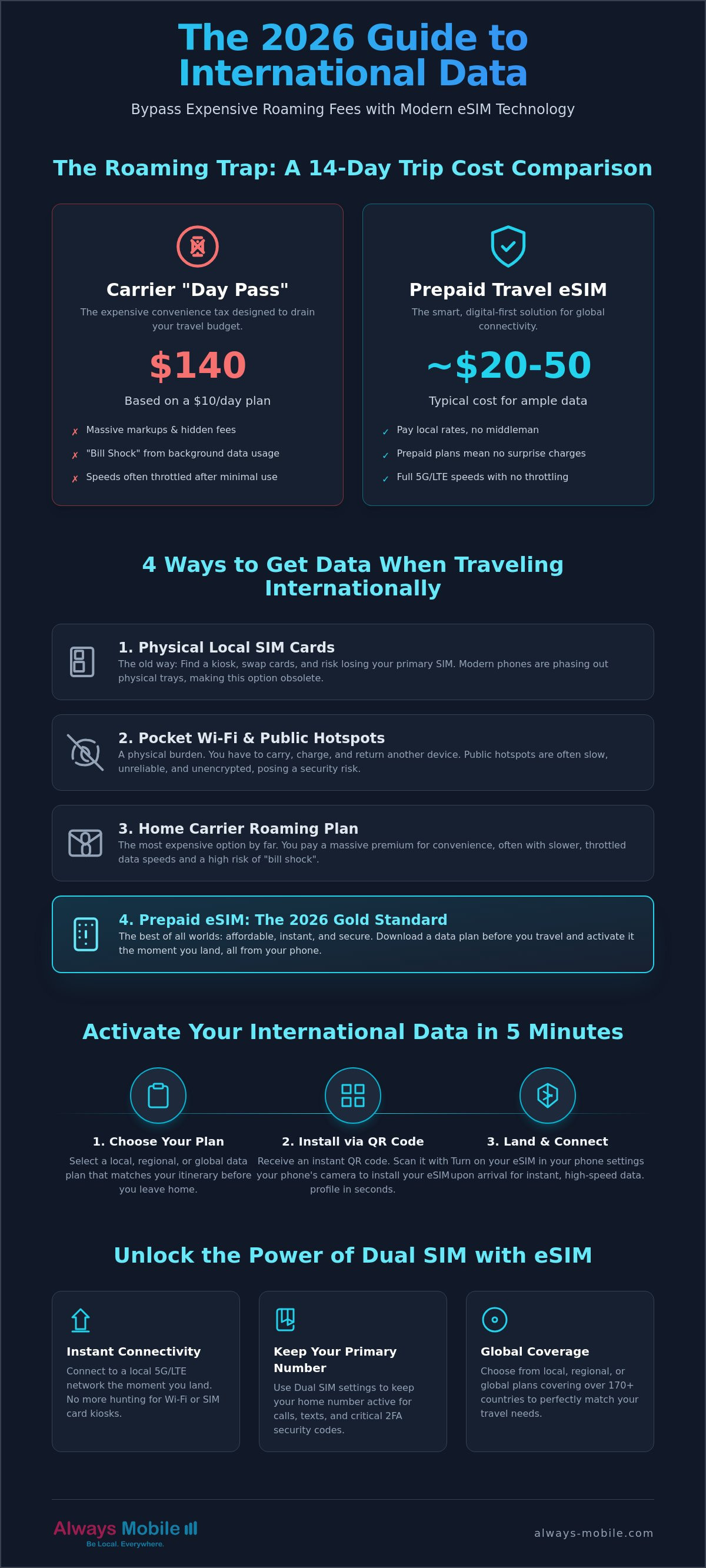
Let's look at the numbers. A standard 14-day trip using a $10 daily carrier pass costs you $140. In contrast, a prepaid travel plan for the same duration typically costs significantly less. You are paying a massive premium just for the "convenience" of not changing a setting. Switching to a digital-first model is the best way to get data internationally with esim because it removes the middleman entirely. You get the same network access as the locals without the corporate markup.
Don't be fooled by "unlimited" labels. Most carrier roaming plans throttle your speeds after a small amount of high-speed usage. You might find yourself stuck with 2G speeds while trying to load a map in a foreign city. Additionally, you're often paying for international minutes and SMS bundles you won't use. In 2026, data is the only currency that matters. With apps like WhatsApp and FaceTime, paying for traditional long-distance calls is a waste of your budget. You can browse all plans by destination to see how much you can save by going direct. Take control of your connectivity and stop subsidizing your carrier's profit margins.
4 Smart Ways to Get Data When Traveling Internationally
Mobile connectivity has evolved rapidly. In 2026, you have four primary choices for staying online abroad: physical local SIM cards, pocket Wi-Fi devices, public hotspots, and travel eSIMs. Choosing the best way to get data internationally with esim depends on your travel style, but the landscape has shifted toward digital-first solutions. Business travelers require high-speed reliability for video calls and secure access to company servers. Leisure travelers need the spontaneity of instant maps and social sharing. For both groups, the Dual SIM setup is the new gold standard. It allows you to keep your home number active for 2FA security codes while routing all heavy data usage through a cheaper local plan.
Physical Local SIM Cards vs. eSIMs
The traditional method of finding a local kiosk after a long flight is fading. It involves navigating language barriers, providing passport details to strangers, and fumbling with tiny pieces of plastic. The risk is high. If you lose your primary SIM card while it's taped to your passport or tucked in a wallet, you lose access to your home identity. Modern 2026 flagship phones are increasingly removing physical SIM trays entirely to save space for larger batteries. If your phone is a recent model, a physical card might not even be an option. This hardware shift makes a digital plan the best way to get data internationally with esim. You can check device compatibility to see if your smartphone is ready for a tray-less experience.
Pocket Wi-Fi and Public Hotspots
Pocket Wi-Fi "pucks" are a physical burden you don't need. They require their own charging cables, add weight to your day bag, and must be returned to a specific location before you fly home. It's another piece of hardware to worry about losing or damaging. Public hotspots are even more problematic. They are often unencrypted, making them prime targets for data theft. Using them for banking or private messages is a massive security gamble. The eSIM security benefits highlighted by the FCC show how digital SIMs provide a private, encrypted connection that public Wi-Fi simply cannot match. "Wi-Fi hunting" ruins the flow of your trip. You shouldn't have to stand outside a cafe just to call a ride or check a reservation. If you want to avoid the hardware hassle entirely, you can browse prepaid data plans that activate the moment you land.
Why Prepaid eSIMs are the 2026 Gold Standard
The 2026 traveler values time and security above all else. Prepaid eSIMs have become the industry benchmark because they eliminate the physical friction of traditional roaming. You no longer need to rely on a single carrier's network or a physical piece of plastic that can be easily lost. Digital SIMs offer a level of flexibility that was impossible just a few years ago. You can store multiple data profiles on a single device and switch between them in seconds as you cross borders. This is the best way to get data internationally with esim for anyone visiting multiple countries in one trip.
Security is another critical factor. Unlike a physical card, a digital SIM cannot be physically stolen or cloned. If your phone is lost, your data plan remains tied to your digital identity, not a removable chip. Environmentally, the shift is significant. Millions of plastic SIM cards end up in landfills every year. By choosing a digital-first solution, you are actively reducing plastic waste and the carbon footprint associated with shipping physical hardware across the globe.
Instant Connectivity Without the Airport Line
Imagine landing after a ten-hour flight and having high-speed 5G the moment you turn off airplane mode. This is the reality of a digital workflow. You buy your plan online, install it while still at home, and activate it the moment your plane touches the tarmac. You avoid the 45-minute queue at destination airport kiosks where travelers scramble for local service. Using local eSIM plans for specific destinations ensures you get the best local rates without ever speaking to a sales agent in a foreign language.
Maintaining Your Digital Identity (2FA and WhatsApp)
The biggest hurdle for travelers used to be losing access to their home phone number. Many banking apps and social platforms require Two-Factor Authentication (2FA) codes sent via SMS. If you swap your physical SIM, you lose that connection. Data-only eSIMs solve this by allowing you to keep your primary line active for texts while routing all data through your travel plan. It is a seamless Dual SIM experience. Apple provides a detailed breakdown on how to use an eSIM abroad to manage these settings effectively. For a deeper look at the technical architecture behind this, read our guide on What is an eSIM Card? to understand how your device handles multiple networks simultaneously. This setup ensures you stay reachable on WhatsApp and secure with your bank, all while enjoying local data speeds.
How to Set Up International Data in 5 Minutes
Setup is the most straightforward part of the process. Forget technical jargon. If you can scan a QR code, you can get connected. This is the best way to get data internationally with esim because it happens on your terms, not the carrier's. You control the activation. You control the cost. Most travelers complete the entire installation before they even finish packing their bags. It's a digital-first workflow that prioritizes your time.
Compatibility and Unlocking
Check your hardware first. Most flagship models from Apple, Samsung, and Google released after 2020 are compatible. Use the Always Mobile compatibility tool to be certain. Crucially, your phone must be carrier unlocked. If you're on a payment plan with a major provider, they might have a software lock on your device. Call them. Ask for an unlock. It's your right once the device is paid for or if you've met their specific criteria. Without an unlocked device, the best way to get data internationally with esim won't work because the software will block the new profile.
Configuring Your Settings for Success
Once your plan is installed, follow the "Golden Rules" for a seamless Dual SIM experience. Go to your Cellular or Mobile Data settings. You need to tell your phone exactly which line to use for specific tasks. This prevents accidental charges and ensures your primary identity remains reachable.
- Primary Line: Set this for 'Voice' and 'SMS'. This allows you to receive those critical 2FA codes for banking and social media without using expensive roaming data.
- Travel eSIM: Set this as the sole source for 'Cellular Data'. This ensures all your browsing, maps, and social media apps use your affordable prepaid plan.
- Data Roaming Toggle: Turn this 'ON' for your travel eSIM. Turn it 'OFF' for your home SIM. This is the single most important step to prevent "bill shock."
- Cellular Data Switching: Disable this immediately. If your travel signal dips, you don't want your phone automatically jumping back to your expensive home network.
Troubleshooting is rarely needed if you follow these steps. If you don't see signal bars immediately after landing, restart your phone. Sometimes the hardware needs a fresh handshake with the local network towers. If you're ready to skip the airport lines and take control of your connection, find your destination plan now and start your trip with total peace of mind. You'll be online before you even reach the arrivals hall.
Choosing the Right Data Plan for Your Itinerary
Selecting a plan shouldn't be guesswork. It depends on your map, your timeline, and your digital habits. The best way to get data internationally with esim is to match the plan to your specific route. If you're staying in one place, a local plan offers the highest value. For example, check out our guide for an eSIM Spain to see how localized coverage works. These plans provide the lowest rates because they tap directly into a single country's infrastructure without the overhead of international roaming agreements.
Regional and Global Strategies
Crossing borders shouldn't mean losing service. If you are backpacking across Europe or touring Southeast Asia, regional eSIM plans are your best tool. They allow you to move between countries without changing digital profiles. One plan covers dozens of neighboring nations. This is perfect for rail trips where you might cross three borders in a single afternoon. For digital nomads on multi-continent tours, a global eSIM provides the ultimate freedom. It keeps you connected across the world with one installation. This eliminates the need to manage multiple accounts or top up in different currencies. For a deeper dive into these long-term tactics, consult our Global eSIM Buying Guide.
Estimating Your Data Needs
Don't overpay for data you won't use. Most travelers overestimate their consumption. Google Maps uses about 5MB per hour of active navigation. Social media scrolling consumes roughly 100MB per 10 minutes. Video calls are the heavy hitters, using up to 1GB per hour in high definition. If you primarily use your phone for navigation and occasional messaging, a 3GB or 5GB plan is usually sufficient for a week of travel. It's a precise way to manage your budget without sacrificing connectivity.
Assess your habits honestly. If you plan to stream video, upload high-res travel vlogs, or work remotely, daily unlimited plans are the safest choice for heavy users. They remove the anxiety of running out of data mid-trip. For lighter users, a fixed data package often lasts the entire journey. Be smart with your settings. Download offline maps before you leave the hotel. Disable auto-updates for your apps. Switch off background app refresh for social media. These small steps preserve your high-speed data for what actually matters. The best way to get data internationally with esim is to be proactive about your usage while enjoying the freedom of local 5G speeds.
Take Control of Your Global Connection
You now have the technical roadmap to eliminate bill shock forever. By adopting a digital-first approach, you bypass carrier monopolies and secure local rates on a global scale. You've learned that leveraging Dual SIM technology to keep your home number active for security codes while routing data through a travel profile is the best way to get data internationally with esim. Whether you're navigating a single city or crossing multiple borders, you are finally in control of your digital utility.
Don't wait until you land to scramble for an insecure signal or hunt for a physical kiosk. Secure your connection before you even head to the airport to ensure total peace of mind. Get connected instantly with Always Mobile eSIM plans and experience local 5G speeds in 170+ countries. Every plan features instant digital delivery 24/7, so you can activate your service whenever you need it. There are no contracts to sign and no hidden roaming fees to worry about. Travel with the confidence that your phone will work the second your wheels touch the tarmac. Your next adventure is waiting.
Frequently Asked Questions
Will I keep my WhatsApp number if I use a travel eSIM?
Yes, you'll keep your original WhatsApp number and all your existing chats. When you install a new data plan, WhatsApp may ask if you want to update your number to the new one. Choose "No" or "Keep" to maintain your current account identity. This allows you to message contacts exactly as you do at home while utilizing high-speed local data for the connection.
Can I still receive calls and texts on my original phone number?
Yes, you can keep your primary line active for incoming calls and SMS while using a separate digital profile for your data. This is the best way to get data internationally with esim while staying reachable for important 2FA security codes from your bank. Just ensure your home carrier's "Data Roaming" is turned off for that specific line to avoid unexpected roaming fees.
Does my phone need to be unlocked to use an international eSIM?
Yes, your device must be carrier unlocked to accept a digital SIM from another provider. If you purchased your phone on a payment plan, it might be software-locked to your home carrier. Contact your provider to request an unlock before you travel. You can verify this status in your phone's settings under "About" and "Carrier Lock" to ensure a smooth installation process.
What happens if I run out of data in the middle of my trip?
You can easily top up your existing plan or purchase a new one instantly through your provider's website. Most digital plans provide real-time usage alerts when you reach specific thresholds of your limit. This ensures you're never left without a connection in an unfamiliar city. Simply select a new package and it will activate immediately without needing to repeat the initial setup.
Is an eSIM faster than using public hotel Wi-Fi?
Yes, a local 5G or 4G connection is often significantly faster and more stable than congested hotel Wi-Fi. Public networks are frequently throttled and shared by hundreds of guests simultaneously, leading to lag and security risks. A dedicated digital SIM connects you directly to local towers, providing a private and secure high-speed link for video calls and streaming without the frustration of shared hotspots.
Can I use my travel eSIM as a personal hotspot for my laptop?
Yes, most prepaid digital plans allow you to use your phone as a personal hotspot for other devices. This is the best way to get data internationally with esim when you need to work from a laptop or share a connection with a tablet. Check your specific plan details to ensure tethering is supported, as it allows you to maintain a secure workspace anywhere you have a signal.
Do I need to delete my home SIM card profile to use a travel eSIM?
No, you don't need to delete your home SIM profile or remove your physical card. Modern smartphones are designed to manage multiple profiles simultaneously. Simply toggle the travel line to "On" for data usage and keep your home line "On" for voice and texts. This Dual SIM functionality is what makes digital connectivity so efficient and stress-free for frequent international travelers.
What should I do if my eSIM doesn't activate immediately upon landing?
Restart your phone first to force a fresh handshake with the local network towers. If that doesn't work, verify that "Data Roaming" is toggled "On" for your travel line in your cellular settings. Ensure your phone is not still trying to search for your home network. Most activation issues are resolved with a simple reboot or by double-checking that the correct line is selected for data.