

For years, the gold standard for Japan travel was the bulky Pocket WiFi rental. In 2026, that "obvious" choice is officially the most inconvenient one. Finding the best way to get internet in japan shouldn't involve standing in airport lines or carrying a second battery pack. You want to land at Narita or Haneda and instantly pull up Google Maps to find your hotel. You shouldn't have to stress about hidden roaming fees or dropping off rental gear before your flight home.
We understand that connectivity is the most important tool in your suitcase. This guide compares every connectivity option available today to help you avoid the common pitfalls of international travel. We look at the latest 5G eSIMs, regional plans, and physical rentals to find the fastest and most reliable solution for your trip. You'll learn how to secure high-speed data without the hardware headache. We'll show you exactly how to stay connected from the moment you touch down until your final Shinkansen ride.
Key Takeaways
- Compare traditional Pocket WiFi against modern digital alternatives to find the most efficient solution for your trip.
- Identify the best way to get internet in japan by evaluating 2026 network speeds and hardware-free connectivity.
- Navigate Japan with confidence using 5G data from top-tier carriers like NTT Docomo and SoftBank.
- Select a data plan tailored to your specific needs, ranging from local daily unlimited options to regional coverage.
- Skip the airport queues and equipment returns with instant delivery and transparent, prepaid pricing.
Table of Contents
Comparing the 4 Main Ways to Stay Connected in Japan
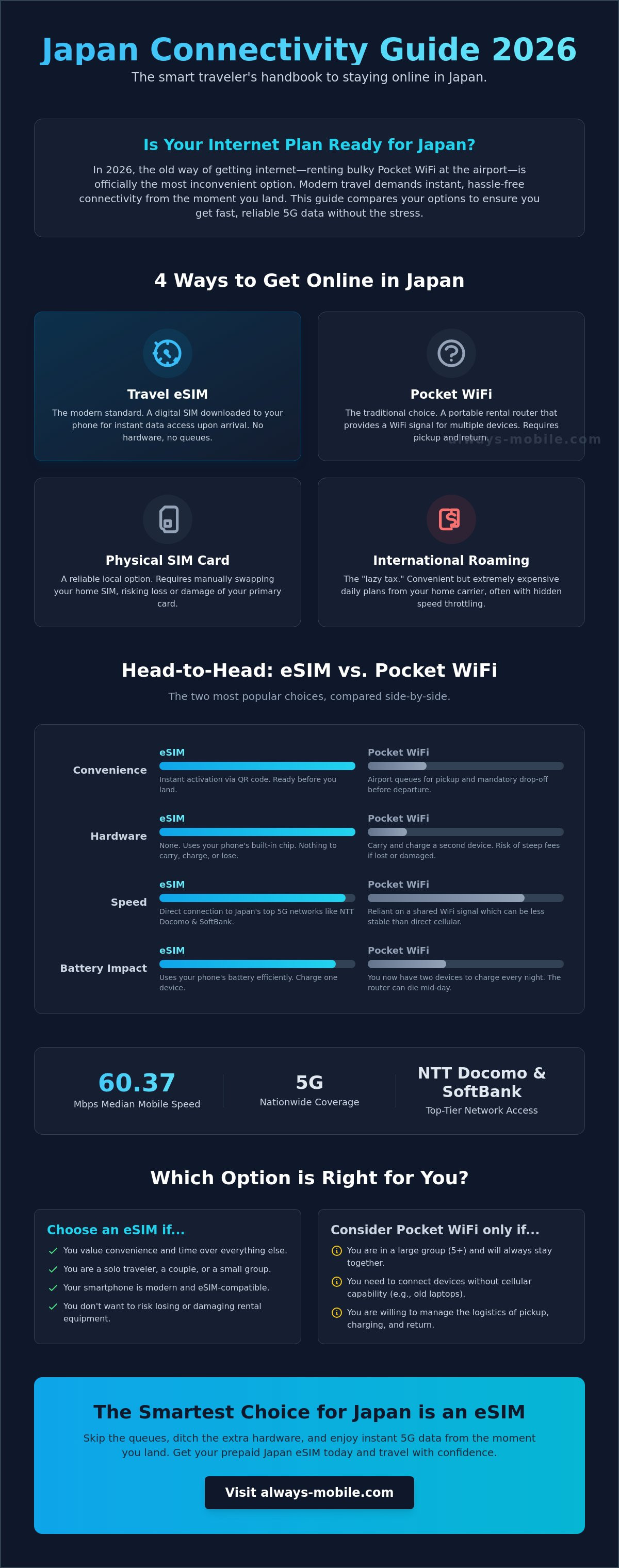
Japan is a world leader in digital connectivity, but your experience depends entirely on how you bridge the gap between your device and the local towers. The Internet infrastructure in Japan is robust, with a median mobile download speed of 60.37 Mbps as of early 2026. To tap into these speeds, you have four main options: international roaming, pocket WiFi, physical SIM cards, and travel eSIMs. Finding the best way to get internet in japan means balancing your need for speed with your desire for a hassle-free vacation.
-
International Roaming: This is often called the "lazy tax" of travel. It requires zero setup, but the daily costs are usually the highest in the industry.
-
Pocket WiFi: These are portable routers that broadcast a signal for multiple devices. They are the traditional choice for families or groups who don't mind carrying extra hardware.
-
Physical SIM Cards: A reliable local option that provides a Japanese data connection. However, it requires you to manually swap your home SIM card, which carries a risk of loss or damage.
-
Travel eSIMs: The modern standard for 2026. This digital solution allows you to download a data plan directly to your phone. It offers instant access without physical logistics.
The Cost of Convenience: Roaming vs. Local Options
Your home carrier likely offers an "International Day Pass." While it sounds simple, these plans are often a financial trap. Daily flat rates can quickly exceed the cost of a full month of local data. Even worse, many roaming plans include hidden throttles. You might start with 5G speeds, but after using a small amount of data, your connection slows down to a crawl. Local prepaid options bypass these home-carrier markups and provide direct access to Japan's 5G networks without the middleman.
Hardware vs. Software: Physical SIMs vs. eSIMs
The shift toward software-based connectivity is accelerating. In 2026, most flagship smartphones are designed with an eSIM-first or eSIM-only approach. Swapping a physical SIM card is becoming a relic of the past. It's a delicate process that requires a SIM tool and a safe place to store your home card. If you lose that tiny piece of plastic, you lose your ability to receive bank verification codes or calls when you return home. Travel eSIMs solve this by living entirely on your phone's internal chip. You scan a QR code, activate the plan, and stay connected. There are no airport queues to join and no hardware to return before your flight home. This makes digital plans the best way to get internet in japan for the modern traveler who values time as much as data.
Pocket WiFi vs. Travel eSIM: Which Is Better for Your Japan Trip?
Choosing between a portable router and a digital plan is the most critical decision for your trip. While many travelers instinctively reach for a rental device, the best way to get internet in japan has shifted toward software-based solutions. Pocket WiFi introduces a physical burden that modern travelers no longer need to accept. You're effectively carrying a second phone that requires its own power source and protective case.
When you rent a Pocket WiFi, you aren't just renting a signal. You're responsible for a physical kit. This includes the router, a charging cable, and often a bulky carrying case. You must navigate crowded airport arrival halls to find a specific pickup counter. At the end of your trip, you have to find a post box or return to a counter before security. If you lose the device or miss the return window, you face steep penalty fees. In contrast, an eSIM exists only on your phone's internal chip. There are no logistics to manage and no physical items to return.
There is a common myth that Pocket WiFi saves your phone's battery. While your phone isn't searching for a cellular signal, it's constantly maintaining a high-power WiFi connection to the router. You now have two devices to charge every night instead of one. If the router dies mid-day, you are effectively offline. With an eSIM, your phone connects directly to Japan's premier networks. According to official 5G population coverage data from the Ministry of Internal Affairs and Communications, these networks now cover nearly every corner of the country. Direct cellular connections often provide more consistent speeds than a shared WiFi signal.
When Pocket WiFi Still Makes Sense
Pocket WiFi remains a niche solution for specific scenarios. If you are traveling in a group of five or more and plan to stay together at all times, sharing one device can be cost-effective. It's also necessary if you're using legacy laptops or tablets that don't support cellular data. Professional videographers who need to upload massive 8K files may also prefer the high data caps of premium rental units.
Why the eSIM Wins for the Modern Traveler
For almost everyone else, the eSIM is the superior choice. You get instant activation the moment your plane touches down. There are no lines to wait in and no envelopes to mail back. Your phone remains slim and pocketable. If you run out of data while exploring a remote temple in Kyoto, you can simply top up your plan through an app. For those planning an extended trip across Asia, consider regional eSIM plans that keep you connected across multiple borders without changing settings. This flexibility makes it the smartest option for 2026.
Japan's Network Landscape: Coverage and Speed in 2026
Identifying the best way to get internet in japan starts with understanding the networks powering your device. Japan's mobile infrastructure is dominated by three giants: NTT Docomo, KDDI (au), and SoftBank. In early 2026, the median mobile download speed reached 60.37 Mbps, a 27.3% increase from the previous year. This growth is driven by the total shutdown of 3G services and a massive push toward mmWave 5G expansion. When you use a local eSIM, you connect directly to these premium towers. This is why local digital plans often outperform international roaming. Roaming users are treated as guests on the network, while local eSIM users receive higher priority for bandwidth and speed.
5G is now the standard in every major Japanese city. Whether you are navigating the underground malls of Osaka or the tech districts of Tokyo, you can expect lightning-fast connectivity. However, network congestion remains a factor. In high-density areas like Shibuya Crossing or during major festivals, 4G LTE often serves as a reliable fallback to keep you connected when 5G bands become crowded. Choosing a provider that offers access to multiple local networks ensures you stay online even in the busiest crowds.
Understanding NTT Docomo vs. SoftBank
NTT Docomo remains the undisputed king of coverage. It holds the largest market share with over 91 million subscribers and offers the most reliable signal in the Japanese Alps, Hokkaido, and remote coastal villages. If your itinerary includes hiking or rural exploration, Docomo is essential. SoftBank, meanwhile, has focused heavily on urban 5G infrastructure. It provides exceptional speeds in metropolitan centers like Nagoya and Fukuoka. Always Mobile simplifies this choice by selecting the strongest available local network for your eSIM, ensuring you don't have to worry about tower proximity.
What Speed Do You Actually Need?
Your data requirements depend on your travel style. Basic navigation via Google Maps and real-time voice translation require very little bandwidth but constant reliability. If you're a content creator, 5G ubiquity is a game-changer. Uploading high-resolution TikToks or Instagram Reels from the top of Tokyo Skytree requires the low latency that only a direct 5G connection provides. For most travelers, the best way to get internet in japan is a solution that handles these high-demand tasks without buffering or data caps. A high-speed 5G connection ensures your maps load instantly, preventing you from getting lost in Japan's famously complex train stations.
Choosing Your Internet Based on Your Traveler Type
Connectivity isn't a one-size-fits-all utility. Your itinerary, group size, and work requirements dictate the best way to get internet in japan. While a solo backpacker values weightless portability, a family of four might prioritize cost-effective sharing. Understanding these nuances helps you avoid overpaying for data you don't need or getting stranded without a signal when your group splits up. Each traveler type faces unique challenges that a digital-first approach can solve instantly.
Internet for Solo and Couple Travelers
Solo travelers and couples benefit most from the freedom of independent connections. Relying on a shared signal means you're tethered to whoever is carrying the router. If one person wants to browse a museum while the other visits a nearby cafe, the connection breaks. Individual local eSIM plans eliminate this friction. They provide a dedicated, secure line for each person, ensuring safety and autonomy. You don't have to worry about staying within ten feet of your partner just to check a train schedule. It's the most efficient way to maintain your independence while exploring complex cities like Tokyo or Osaka.
Solutions for Families and Small Groups
Families often fall into the "Tethering Trap." This occurs when a group relies on a single Pocket WiFi device to save money. In reality, this leads to logistical headaches. If a teenager wanders off in a crowded Harajuku department store, they lose access to maps and messaging instantly. This creates unnecessary anxiety. Buying separate eSIMs allows for "split-group" flexibility. You can divide your party between different shops or attractions without losing contact. When you calculate the total cost, four affordable eSIMs often rival the price of one high-end rental router. You also avoid the liability of a physical device that could be lost or broken by children.
Business travelers and digital nomads require a balance of high-volume data and rock-solid security. Public WiFi in Japanese cafes is rarely encrypted and often unreliable for professional use. A dedicated mobile connection provides a private tunnel for sensitive work emails and video calls. It also simplifies logistics. Digital plans generate instant receipts, making expense reporting straightforward. For those moving between Japan and other Asian hubs like Seoul or Taipei, using global eSIM plans offers a seamless transition. You maintain connectivity across borders without the need to purchase new data packages or swap hardware in every country.
Why an Always Mobile eSIM is the Smartest Choice for Japan
Always Mobile provides the best way to get internet in japan by removing every traditional barrier. You don't need to wait for shipping or stand in a queue at the airport. Purchase your plan online. Receive your QR code via email immediately. This digital-first approach ensures you have a working connection before you even step off the plane. It's the ultimate solution for travelers who value efficiency. For anyone seeking the best way to get internet in japan, the answer lies in a plan that requires zero physical logistics and zero extra hardware.
Transparency is at the core of our service. Unlike home carriers that hide fees in complex contracts, our plans are entirely prepaid. You know exactly what you're paying upfront. There are no hidden charges, no activation fees, and no overage surprises. If you use all your data, your connection simply stops or throttles until you choose to top up. This eliminates the "bill shock" that often follows international trips. You stay in complete control of your travel budget from day one.
Our technology is built for 2026. You get full access to Japan's premier 5G networks. With the 3G shutdown complete as of March 2026, having a modern, 5G-ready plan is essential for reliable coverage in both cities and rural prefectures. Whether you need Local eSIM Plans for a short stay or Daily Unlimited eSIM Plans for heavy usage, we provide direct access to the fastest towers available. You won't have to deal with the lag or deprioritization often found with international roaming.
A Frictionless Start to Your Adventure
Skip the airport crowds. Most travelers waste their first hour in Japan standing in line for a physical SIM or a rental WiFi router. With an eSIM, you bypass the chaos. You also keep your primary phone number active. This is crucial for receiving bank authentication codes or using WhatsApp with your original identity. You use our data for the heavy lifting while your home SIM stays in place for emergencies. If your trip extends beyond your original plan, top up your data in seconds through our website without needing to visit a store.
Ready to Connect?
Before you buy, confirm your device compatibility. Most modern smartphones released since 2020 are ready for digital plans. Once confirmed, select the plan that fits your itinerary. We offer fixed data buckets for light users and Daily Unlimited eSIM Plans for those who need constant connectivity for social media and navigation. Don't leave your trip to chance. Get your Japan Travel eSIM today and experience the freedom of instant, high-speed data.
Ready for an Effortless Japan Experience?
Japan's connectivity landscape has evolved. Bulky rental routers and expensive roaming plans are now relics of the past. For the modern explorer, the best way to get internet in japan is a digital-first approach that prioritizes speed and simplicity. You gain direct access to premier 5G networks without the burden of physical hardware or airport queues. This transition ensures you spend more time exploring and less time managing equipment.
Always Mobile makes this process entirely seamless. Benefit from instant digital delivery of your data plan right to your inbox. There is no physical SIM swapping required; your original number stays active for essential messages and verification codes. You get reliable 5G performance across the country, from Tokyo's neon streets to the quiet trails of the Japanese Alps. It's time to remove the friction from your travel plans. Secure your high-speed Japan eSIM from Always Mobile now. Enjoy your adventure with the confidence that you're always connected.
See additional information on our Japan eSIM plans.
Frequently Asked Questions
Is it better to get a SIM card or Pocket WiFi in Japan?
An eSIM is the superior choice for most individual travelers and couples because it requires zero physical hardware. You avoid the hassle of carrying an extra device, managing a second battery, or returning equipment at the airport. Pocket WiFi is only recommended for large groups of five or more who plan to stay together at all times or for those using legacy devices that lack eSIM support.
Can I use my own phone's data plan in Japan?
You can use international roaming through your home provider, but this is rarely the best way to get internet in japan due to high costs. Most carriers charge expensive daily flat rates that offer limited high-speed data. Switching to a local digital plan allows you to access Japan's 5G networks at local prices while avoiding the "lazy tax" of roaming fees.
Does Japan have free public WiFi for tourists?
Free WiFi is available at major airports, train stations, and convenience stores, but it is often unreliable for real-time navigation. These networks can be slow, require complex registration, and present security risks for sensitive tasks. Relying on public hotspots makes it difficult to use Google Maps or translation apps while walking between destinations.
What is the cheapest way to get internet in Japan?
Digital eSIM plans are currently the most cost-effective solution for travelers. They provide the best way to get internet in japan by offering competitive local rates without the shipping fees or rental deposits required for physical hardware. You can choose a plan that matches your exact duration, whether you need a small data bucket or a daily unlimited option.
Will my phone work with a Japanese eSIM?
Your phone will work if it is carrier-unlocked and was manufactured after 2020. Most modern flagship devices, including the iPhone 12 and newer or the Samsung Galaxy S21 series, support this technology. Always verify that your specific model is compatible and that your home carrier has removed any network locks before you depart for your trip.
How do I activate an eSIM once I arrive in Japan?
Activation is a simple three-step process that takes only a few minutes. Scan the QR code provided in your confirmation email, follow the prompts in your phone's settings to add the new cellular plan, and turn on data roaming for that specific line. You will connect to a local network like NTT Docomo or SoftBank the moment you land.
Is 5G widely available across Japan in 2026?
5G is now ubiquitous in all major metropolitan areas and many rural prefectures. Following the official shutdown of 3G networks in March 2026, Japanese carriers have aggressively expanded their 5G infrastructure. You can expect lightning-fast speeds in cities like Tokyo, Osaka, and Kyoto, with reliable 4G LTE coverage serving as a fallback in more remote mountainous regions.
Can I make phone calls with a data-only eSIM in Japan?
You cannot make traditional cellular calls or send SMS messages because these plans do not include a Japanese phone number. However, you can use any internet-based communication app to stay in touch. Apps like WhatsApp, FaceTime, and LINE work perfectly over your data connection for high-quality voice and video calls without additional charges.