

That $12 daily roaming fee from your carrier isn't a convenience charge. It's a "roaming trap" designed to inflate your bill while you're focused on your vacation. Most travelers accept these high costs because they fear "bill shock" or find technical terms like eSIM and APN settings confusing. You don't have to settle for overpriced plans to get cheap mobile data for traveling abroad.
We understand the frustration of landing in a new country and feeling disconnected. You shouldn't have to waste your first hour of vacation hunting for a local SIM shop at a crowded airport. This guide reveals how to slash your international phone bill by up to 90% using modern digital SIM technology. It's about matching the right digital architecture to your specific itinerary for maximum savings.
You'll learn how to bypass traditional carrier fees and access high-speed 5G networks with predictable, prepaid costs. We'll compare current 2026 roaming rates from major providers against more agile alternatives. From local and regional plans to global coverage, here is your roadmap to instant, affordable connectivity the moment you touch down.
Key Takeaways
- Identify the "roaming trap" and learn why paying for what you use is often smarter than expensive unlimited daily passes.
- Compare the top three methods for securing cheap mobile data for traveling abroad to find the best fit for your specific itinerary.
- Use regional plans to maintain high-speed 5G access across multiple countries without ever swapping a physical SIM card.
- Break down your app usage to ensure you're only paying for the data you actually need for maps, social media, and streaming.
- Transition to a digital-first setup that offers instant connectivity and eliminates the risk of surprise international charges.
The Roaming Trap: Why "Standard" International Data is Never Cheap
Traditional mobile carriers treat international borders like high-priced toll booths. When you leave your home network, your device begins "roaming." This process involves your provider paying a foreign network to host your connection. They then pass that cost to you with a significant markup. Start by understanding roaming as a system built for the carrier's profit, not your budget. It is a legacy model that relies on traveler convenience to justify inflated prices.
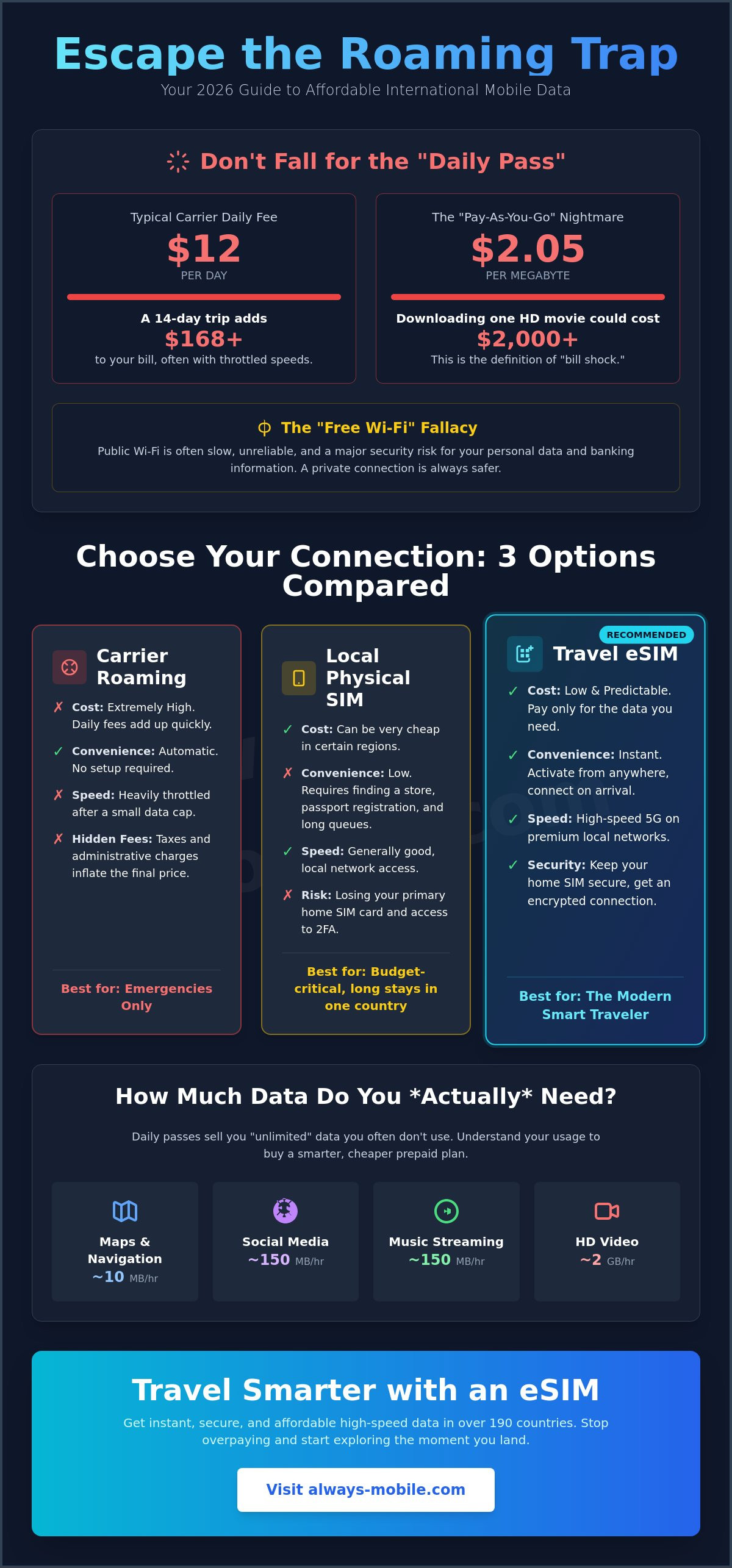
The "Bill Shock" phenomenon is still a reality in 2026 for those using legacy pay-as-you-go rates. While many carriers have moved to daily passes, some standard rates still hover around $2.05 per megabyte. At that price, downloading a single high-definition movie or syncing your photo library could cost over $2,000. It is an trap designed for a time before high-speed 5G and data-heavy social apps. You need a more agile solution to find cheap mobile data for traveling abroad.
Relying on "Free Wi-Fi" is another common mistake. It is rarely cheap when you factor in the cost of your time and digital safety. Public networks in cafes and airports are notoriously slow and congested. More importantly, they are often unencrypted and vulnerable to security breaches. Using a private digital SIM provides a secure, encrypted connection that protects your banking info and personal data while you travel. Don't trade your identity for a few saved dollars.
The Hidden Costs of Traditional Roaming
Daily flat fees look predictable on paper, but they are often inefficient. Major US carriers typically charge $12 per day for international access. On a 14-day trip, that adds $168 to your monthly bill. These plans often include "unlimited" data that is heavily throttled. Once you hit a small high-speed threshold, your connection drops to 3G speeds, making maps and translation apps unusable. Administrative fees and local taxes further inflate the advertised price, leaving you with a final bill that is higher than expected.
Why Digital SIMs are the 2026 Standard
The era of hunting for physical plastic cards is over. Transitioning to what is an eSIM card is the most efficient way to manage your connection. It eliminates the "airport SIM shop" tax where vendors charge a premium for the convenience of being the only shop in the terminal. You no longer have to wait in long queues with your passport in hand just to get online.
Digital SIM technology allows for instant activation. You can purchase your plan at home and connect to a local 5G network the moment the plane wheels touch the tarmac. This speed ensures you can call a ride-share or check hotel directions immediately. It is a seamless, professional approach to staying connected without the carrier markup.
Comparing the Top 3 Ways to Get Cheap Mobile Data Abroad
Finding the absolute cheapest way to stay connected depends on your destination and your technical comfort level. While some travelers still swear by local vendors, others prefer the predictable costs of a travel-specific plan. When evaluating the best international phone plans, you generally choose between carrier roaming, physical local SIMs, or travel eSIMs. Each path impacts your wallet and your travel experience differently. Pay close attention to network tiering. Some budget-tier providers purchase lower-priority bandwidth. This means your "5G" connection might feel like 3G during peak hours in crowded cities because the local network prioritizes its own direct subscribers.
Local Physical SIMs: The Old School Choice
In developing markets across Southeast Asia or parts of South America, a local physical SIM is often the cheapest mobile data for traveling abroad. You can sometimes find 20GB of data for under $10 in these regions. However, the cost advantage is shrinking in developed nations like Japan or the UK. In many countries, you must present a physical passport for registration. This leads to long queues at airport kiosks where prices are often higher than in the city center. There is also a physical risk to consider. Swapping your primary SIM card on a moving train or in a busy cafe is a recipe for disaster. If you lose that tiny piece of plastic, you lose access to your home number and crucial two-factor authentication for your bank and email.
Travel eSIMs: The Modern Budget King
Travel eSIMs have become the standard for efficient travelers in 2026. They offer the price advantages of local networks without the logistical headaches. Utilizing local eSIM plans allows you to bypass the airport kiosk entirely. You download your profile before you leave, activate it upon landing, and you are online instantly.
One major advantage competitors often overlook is the ability to keep your original phone number active for apps like WhatsApp and iMessage. Modern smartphones allow for Dual-SIM functionality. You can keep your home SIM active for incoming SMS while routing all expensive data through your travel eSIM. Simply navigate to your cellular settings to set the eSIM as the primary data line. This ensures your messaging apps stay linked to your primary number without incurring roaming fees. It is a completely prepaid system, so you spend exactly what you planned with no risk of overage charges. If you want a stress-free start to your trip, consider browsing prepaid data options that fit your specific destination.
Calculating Your Data ROI: How Much Do You Actually Need?
Stop guessing how much data you need. Most travelers overspend on "unlimited" plans they never fully utilize. Securing cheap mobile data for traveling abroad isn't about finding the biggest bucket. It's about matching your bucket to your actual consumption. A plan with 1GB of data is significantly cheaper than an unlimited plan if you only use 800MB. Do the math before you buy. Check your previous trip's data usage in your phone settings to establish a realistic baseline.
Apps consume data at wildly different rates. Google Maps is surprisingly efficient, using roughly 5MB per hour of active navigation. Social media apps like Instagram or TikTok are the real "Data Vampires." Ten minutes of scrolling can easily eat 100MB. High-definition video streaming is the fastest way to drain a plan, consuming up to 3GB per hour. Pinpoint exactly which apps you need while on the move. Save the heavy lifting like photo backups or app updates for your hotel Wi-Fi.
Stretch your small data plan by using offline features. Download Google Maps for your destination city before you leave home. This allows for GPS navigation without using a single kilobyte of mobile data. Disable "Background App Refresh" and "Automatic Updates" in your device settings. These hidden processes run in the background, consuming data without your knowledge. Managing these settings ensures every megabyte you pay for goes toward your actual travel needs.
The Light Traveler Profile (1-3GB per week)
This profile fits those who focus on navigation, messaging, and occasional web searches. If you are on a short city break, a 1GB or 3GB plan is usually sufficient. Stick to text-based communication. Avoid uploading high-resolution videos until you reach a stable Wi-Fi connection. By downloading maps and music for offline use, you can maintain a high-speed connection for essential tasks while keeping costs at an absolute minimum.
The Power User & Digital Nomad (10GB+ or Unlimited)
Work-related tasks require a different strategy. If you need to attend video conferences or upload large content files, choose "Daily Unlimited eSIM Plans" for peace of mind. These plans remove the anxiety of hitting a cap mid-meeting. Consider the cost-benefit of Regional or Global eSIM Plans if your trip spans multiple countries over several months. While a local plan is cheaper for a single country, a regional plan saves you the time and effort of purchasing new data every time you cross a border.
2026 Roundup: The Best Strategies for Low-Cost Travel Connectivity
If your itinerary involves crossing multiple borders, buying separate local SIMs is inefficient. You lose time finding shops and money on unused data. The smartest strategy for multi-stop trips is utilizing regional eSIM plans. These allow you to maintain a single connection across entire continents like Europe or Asia. You cross the border, your phone finds the new network, and you stay online. It is the definitive "Country-Hopping" strategy for 2026.
For those on open-ended adventures, a global eSIM provides the ultimate flexibility. While local plans are often cheaper for a single destination, the global option removes the friction of managing multiple profiles. It is the best way to secure cheap mobile data for traveling abroad when your path is unpredictable. Modern apps also offer "Top-Up" features. This prevents the common mistake of overbuying data. Start with a smaller plan and add more megabytes only if you actually need them. You spend exactly what is necessary and nothing more.
Best Strategies for Europe and North America
Europe is uniquely traveler-friendly due to regional roaming regulations. A single plan often covers all EU member states at no extra cost. However, North America requires more care. The USA uses specific network bands for 5G and LTE. Always verify that your device is compatible with local carriers before you land. Look for regional bundles that include the US, Canada, and Mexico to avoid high-cost North American roaming traps. This ensures you maintain 5G speeds without paying "airport prices" for local service.
Saving Money in Asia and the Middle East
Markets like Japan and the UAE are notoriously expensive for casual roaming. In these tech-forward hubs, 5G is the standard. Don't settle for 4G-only plans that leave you with lagging maps or slow translation apps. In data-heavy regions where you'll be streaming or using video calls constantly, "Daily Unlimited" plans offer the best value. They provide a fixed cost per day with no fear of hitting a cap. Avoid the stress of searching for Wi-Fi and get your Always Mobile eSIM before you depart to ensure instant, high-speed access the moment you land.
Always Mobile: The No-Nonsense Solution for Affordable Global Data
Managing international connectivity shouldn't feel like a second job. Always Mobile eliminates the complexity of finding cheap mobile data for traveling abroad by stripping away the bureaucratic layers of traditional carriers. You don't have to deal with physical storefronts, credit checks, or restrictive monthly contracts. We offer a digital-first approach that prioritizes your time and your budget. It's a clean, transparent system designed specifically for the modern traveler who values efficiency above all else.
Setup takes less than three minutes from purchase to connection. You receive a digital profile, follow a few simple prompts on your device, and you're ready to go. There are no hidden administrative fees or surprise taxes added at checkout. You pay for the data you need and nothing more. Because travel doesn't stop, our support team remains available 24/7 to ensure your connection stays active regardless of your time zone. Connectivity should be a utility, not a source of stress.
Why Travelers Trust Always Mobile
Reliability is built into our network architecture. We provide access to premium local 4G and 5G networks in over 170 countries. This ensures you get high-priority bandwidth rather than the throttled secondary connections often found with budget-tier competitors. Our flexible lineup includes Local eSIM Plans for single-country trips, Regional eSIM Plans for continental adventures, and Global eSIM Plans for world travelers. If you're a high-volume user, our Daily Unlimited eSIM Plans offer a predictable daily rate with zero data anxiety. Our technology is universally compatible with any eSIM-enabled iPhone or Android device, making the transition from your home carrier entirely effortless.
Ready to Travel? Your Cheap Data is One Click Away
Getting started is straightforward. Select your destination on our platform, choose the data volume that matches your specific profile, and complete your purchase. Installation is a one-time process. Once your eSIM is on your device, you can toggle it on the moment you land. Stay in control of your spending by monitoring your usage in real-time through your account dashboard. You'll never be surprised by a bill shock or a "roaming trap" again. Stop overpaying for basic access and start exploring with confidence. Get connected instantly with Always Mobile today.
Connect Smarter on Your Next Adventure
The era of returning home to a massive phone bill is officially over. By avoiding the legacy carrier "roaming trap" and embracing digital SIM technology, you regain total control over your travel budget. Remember to calculate your actual data ROI based on the specific apps you use most. Whether you need a light 1GB pack for a quick city break or a robust regional plan for a multi-country tour, the right digital architecture ensures you never overpay for high-speed access.
Transitioning to a modern setup means you can secure cheap mobile data for traveling abroad without the stress of airport kiosks or registration queues. You deserve a reliable connection that works the moment your plane touches the tarmac. Always Mobile provides instant activation in over 170 countries with zero roaming fees. With daily unlimited data options available, you can focus on making memories instead of hunting for unreliable public Wi-Fi. It is time to travel with the confidence of a truly connected explorer.
Get cheap mobile data for your next trip with Always Mobile and experience the freedom of seamless global connectivity. Your next destination is waiting.
Frequently Asked Questions
Is an eSIM really cheaper than my current international roaming plan?
Yes, switching to a digital SIM is almost always more cost-effective than standard carrier roaming. Major providers like Verizon and AT&T typically charge $12 per day for international access. A travel eSIM allows you to bypass these high daily fees by connecting directly to local networks at local rates. You pay only for the data you need, often saving up to 90% compared to legacy roaming plans.
Can I still use my phone number for calls and texts with a data-only eSIM?
You can keep your original phone number active for calls and SMS while using a separate plan for data. Modern smartphones utilize Dual SIM technology to run two lines simultaneously. Set your home SIM to handle voice and your travel eSIM to handle data. This configuration ensures you still receive important bank authentication texts and keep your primary number linked to WhatsApp or iMessage.
Will a cheap travel eSIM work in every country I visit?
Coverage depends entirely on the specific plan you purchase. Local plans are designed for a single country, while regional plans cover dozens of nations across entire continents like Europe or Asia. If your trip spans multiple continents, a global plan is the most efficient choice. Always review the included country list before buying to ensure you have 5G or 4G access in every destination on your itinerary.
How much data do I actually need for a one-week trip abroad?
Most travelers find that 2GB to 3GB is sufficient for a typical seven-day vacation. This allowance easily covers GPS navigation, social media updates, and messaging. If you plan to stream high-definition video or work remotely, you should consider a 10GB pack or an unlimited daily plan. Tracking your usage in real-time helps you maintain cheap mobile data for traveling abroad without the risk of running out mid-trip.
Do I need to unlock my phone to use a travel eSIM?
Yes, your smartphone must be carrier-unlocked to support a third-party digital SIM. If you purchased your device directly from a carrier on a payment plan, it might still be locked to their network. Check your settings or contact your provider to confirm your status before you depart. Once unlocked, your phone can host multiple eSIM profiles from different providers around the world simultaneously.
What happens if I run out of data while I am traveling?
Running out of data is a simple problem to fix with instant top-ups. You don't need to find a physical store or install a new profile on your phone. Simply log into your account dashboard and add more data to your existing plan. The new balance applies immediately, ensuring you stay connected without any downtime or the need to reconfigure your device settings while on the move.
Is 5G data included in cheap international eSIM plans?
High-speed 5G access is included in most plans wherever the local infrastructure supports it. In tech-forward hubs like Japan, South Korea, and most of Europe, you can expect 5G speeds as the standard. If you are in a more remote area or a region without 5G, your device will automatically switch to the fastest available 4G or LTE network to maintain a reliable connection.
Can I share my cheap mobile data with other devices via hotspot?
Most travel eSIMs fully support personal hotspots and tethering. This is an efficient way to provide a secure internet connection to your laptop, tablet, or a travel companion's smartphone. Be aware that tethering multiple devices will consume your data balance much faster than browsing on a single phone. Keep an eye on your real-time usage to ensure you don't exhaust your plan prematurely.