

That tiny plastic card you've swapped with a paperclip for years is officially a travel liability. With 2026 flagship devices like the iPhone 17 Air moving to eSIM-only designs, the hardware you're used to is becoming a relic. You likely hate the stress of fumbling with small parts or the fear of losing your home SIM in a foreign airport. It's a common anxiety. The high cost of traditional carrier roaming only makes it worse. This comparison of esim vs physical sim technology gives you the clarity needed to choose the best connection for your next trip.
Discover how to ditch the plastic and embrace a digital-first approach. We'll explain how to save up to 95% on data costs while securing instant access the moment you touch down. This guide covers the latest GSMA standards and 2026 device compatibility to ensure you never face a connectivity gap. Learn how to manage your data through local, regional, or global plans. We'll also explain why pre-installing your profile is critical for destinations like Turkey or the UAE. Leave the roaming charges and the tiny SIM tools behind for good.
Key Takeaways
- Learn why storing multiple network profiles on a single digital chip beats carrying a wallet full of plastic cards.
- Understand the security advantages of embedded hardware that can't be physically removed or easily cloned if your device is lost.
- Master the "Traveler’s Setup" by using Dual SIM technology to keep your home number active for 2FA while using travel data.
- Evaluate the technical trade-offs of esim vs physical sim to stop wasting time at airport kiosks and start browsing the moment you land.
- Streamline your next trip with a 3-minute setup process that provides instant access to local, regional, or global data plans.
Table of Contents
The Evolution of Mobile Identity: From Plastic to Embedded
Think of your Subscriber Identity Module (SIM) as a digital passport. It holds the unique credentials that link your device to a mobile network. For decades, this identity was tied to a physical object. We watched these cards shrink from the size of a credit card to the tiny Nano-SIM. This progression was always about saving space. Now, the hardware is disappearing entirely.
2026 marks a definitive tipping point for universal adoption. The number of eSIM-enabled devices shipped this year is projected to exceed 633 million. Flagship phones like the iPhone 17 Air and the US models of the Google Pixel 10 have removed the traditional card slot altogether. The esim vs physical sim debate is no longer just for tech enthusiasts. It's the new standard for anyone crossing a border.
The Legacy of the Physical SIM Card
Physical SIMs are removable chips that store authentication keys. They've been the industry standard since the 1990s. While reliable, they have clear physical limitations. Every SIM tray represents a hole in your phone's chassis. These openings invite dust and water damage. They also consume valuable internal space that could house a larger battery or better sensors.
Managing multiple physical cards is a traveler's headache. You have to store your home SIM safely while fumbling with a paperclip in a crowded airport. It's a manual, error-prone process. In 2026, the mechanical SIM tray is a relic of 2010s technology. It's a physical solution in an increasingly digital world. This legacy hardware creates friction that modern travelers no longer need to tolerate.
The Rise of the Embedded SIM (eSIM)
An eSIM is a permanent, programmable chip soldered directly into your device's motherboard. It follows strict GSMA standards for security and interoperability. As of April 24, 2026, the active consumer specification is SGP.22 v2.7. This standard allows for remote provisioning, which means you can download a network profile over the air. You don't need to visit a kiosk or wait for a delivery. eSIM technology removes the barriers of physical distribution.
This shift allows you to store multiple profiles on one device. You can switch from a local plan to a regional one with a few taps. There's no plastic waste and no risk of losing your primary card. Digital SIMs provide immediate connectivity the moment you land. An eSIM is a software-based evolution of mobile hardware that transforms a physical object into a digital service.
Technical Breakdown: How eSIM and Physical SIMs Compare
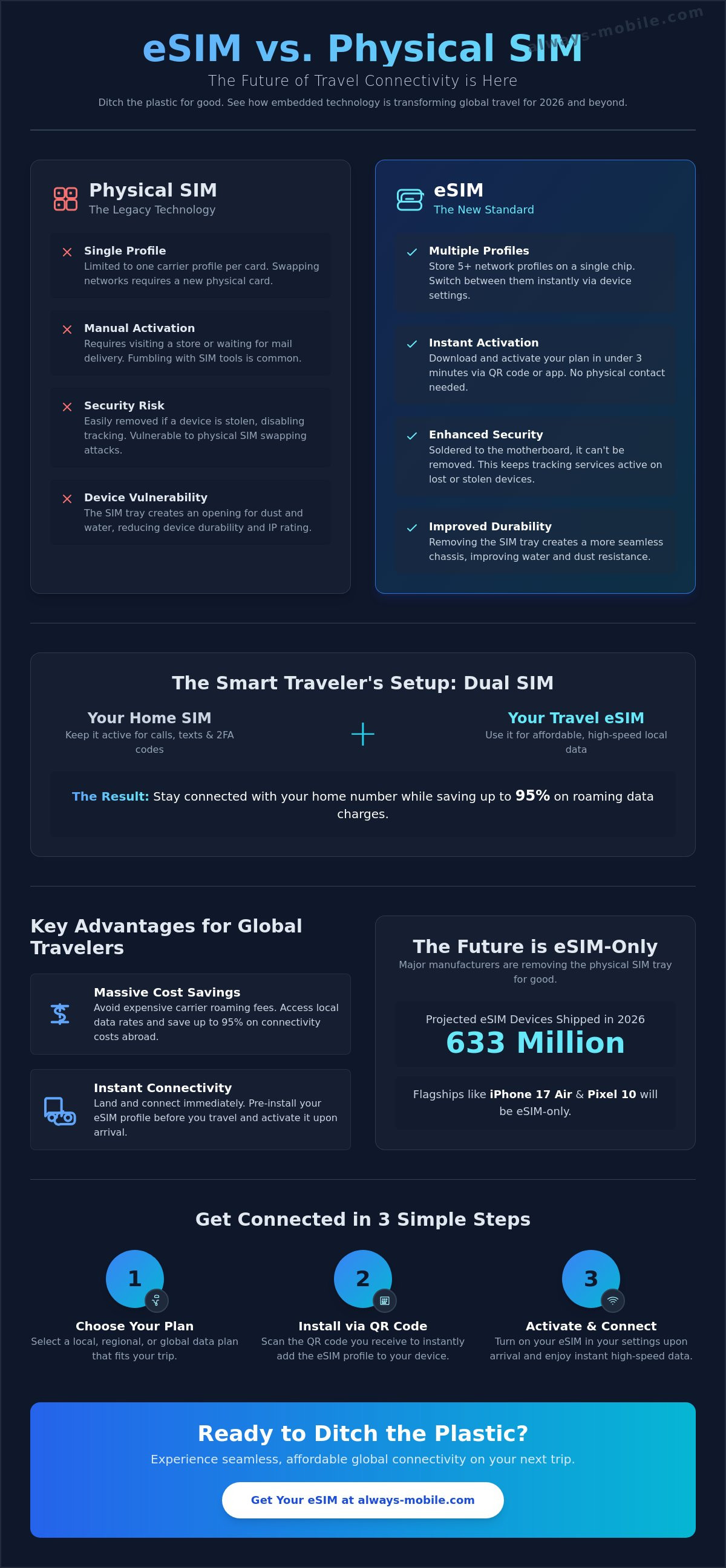
The technical gap between esim vs physical sim solutions comes down to capacity and speed. A physical card is limited to a single carrier profile. If you want a new network, you need a new piece of plastic. Modern eSIM chips change this by storing multiple digital profiles simultaneously. You can toggle between five or more networks through your phone settings without touching a single component. This flexibility is essential for travelers moving between regions.
Activation speed is another major differentiator. Physical cards rely on the mail or a visit to a retail store. This creates a delay. In contrast, digital profiles download in seconds. When comparing eSIM and physical SIM performance, remember that the signal quality remains identical. The difference lies entirely in how you access the network. Digital delivery removes the logistics of shipping and the wait times of retail lines.
Security and Theft Protection
Security is where embedded technology truly excels. A physical SIM is easy to remove. If your phone is stolen, a thief can eject the card to kill the cellular connection and stop tracking services. An eSIM is soldered to the motherboard. It stays active even if the device is powered down or locked. This makes it much harder for thieves to hide a stolen device from "Find My" services.
Identity theft is also harder to execute. Traditional SIM swapping involves a hacker tricking a carrier into porting your number to a new physical card. Digital provisioning uses advanced encryption and secure server-to-chip handshakes. This protects your authentication keys from being intercepted. It's a safer way to manage your mobile identity while exploring new countries.
Space and Hardware Efficiency
Removing the SIM tray is a win for device durability. Every opening in a phone chassis is a point of failure for water and dust resistance. By eliminating the mechanical slot, manufacturers can achieve higher IP ratings. This hardware efficiency also creates room for larger batteries and improved thermal cooling systems. Understanding what is an esim card explains how these chips enable the ultra-thin, sleek designs of 2026 flagship handsets.
This space-saving design is critical for smaller wearables like smartwatches and AR glasses. These devices don't have room for a bulky plastic tray. Digital chips allow them to stay connected independently. If you're planning a trip soon, consider how regional eSIM plans can simplify your data needs across multiple borders without the hardware hassle.
The Traveler’s Perspective: Why Digital Profiles Win Abroad
The "Airport Swap" is a traveler's rite of passage that should've stayed in the 2010s. We've all been there. You land after a ten-hour flight and immediately start fumbling for a paperclip or a needle. You carefully eject your home SIM card while balancing on a cramped airplane seat. One wrong move and that tiny piece of plastic disappears into the floor tracks forever. This mechanical nightmare is the primary reason travelers are shifting the esim vs physical sim debate toward digital solutions.
Waiting in line at a foreign kiosk is a waste of your limited vacation time. You often face language barriers, passport registration requirements, and overpriced "tourist" plans. Digital profiles eliminate this friction entirely. By following GSMA's eSIM specifications, modern devices allow you to download your network credentials before you even leave home. You get instant connectivity the moment the plane wheels touch the tarmac. It's about immediate relief and removing traditional barriers.
Eliminating International Roaming Anxiety
Home carriers often hide predatory fees in the fine print. Major US carriers in 2026 typically charge $10 to $15 per day for international roaming. On a two-week trip, you're looking at an extra $210 just for data you've already paid for at home. Using local eSIM plans bypasses these daily passes. You pay a transparent, prepaid price upfront. There's no bill shock when you return home.
Prepaid data puts you in control. You choose exactly how much data you need and for how long. Imagine landing in London and having 5G active before you've even cleared immigration. You can call an Uber, check your hotel location, and message your family without worrying about a "Daily Pass" notification hitting your inbox. It's a smarter, more agile alternative to legacy roaming systems.
Managing Multiple Destinations
Backpackers and digital nomads face unique challenges when crossing multiple borders. Carrying a collection of physical cards for France, Germany, and Italy is a logistical mess. A global eSIM or regional plan solves this by covering entire continents under a single profile. You can stack multiple profiles on your device and toggle between them as you cross borders with a few taps.
Regional plans offer the perfect middle ground for cost and convenience. If you're on a multi-country Euro-trip, one regional plan keeps you connected from Lisbon to Ljubljana. Just remember that some countries like Turkey, the UAE, or India require you to install the profile before you enter their borders. Plan ahead to ensure your transition is entirely effortless. Digital-first connectivity means your data travels as fast as you do.
Managing Your Connectivity: Dual SIM and Compatibility
Modern travel doesn't require choosing between your home phone number and affordable local data. Most smartphones released by 2026 utilize Dual SIM Dual Standby (DSDS) technology. This feature allows your device to stay active on two different networks at once. When weighing the practical use of esim vs physical sim, DSDS is the clear winner for maintaining your digital life. You can keep your primary line active for essential tasks while a secondary digital profile handles your heavy data lifting.
The "Traveler’s Setup" is the most efficient way to stay connected. Keep your original physical SIM (or primary eSIM) active to receive incoming SMS messages and Two-Factor Authentication (2FA) codes (if allowed by your home mobile company). These are often free to receive even when abroad. Simultaneously, use a dedicated travel plan for all your maps, social media, and browsing. This setup ensures you never lose access to your banking apps or work accounts while avoiding the high costs of international data roaming.
Configuring Your Phone for Dual Connectivity
Setting up your dual-network environment is a straightforward process. Follow these logical steps to ensure your phone uses the correct connection for the right task:
-
Assign Data: Go to your cellular settings and set "Cellular Data" specifically to your travel eSIM.
-
Assign Voice: Set your "Default Voice Line" to your primary home SIM.
-
Lock Data Switching: Toggle "Allow Cellular Data Switching" to OFF. This prevents your phone from accidentally using expensive home data if the travel signal dips.
-
Disable Roaming: Turn off "Data Roaming" on your primary line. Keep it ON only for the travel eSIM.
This configuration creates a firewall against accidental charges. You stay reachable on your home number without the risk of a surprise bill. Ready to start your journey? Select your destination and get connected instantly with a dedicated travel plan.
Device Compatibility Check in 2026
The transition to digital-only hardware is accelerating. As of 2026, over 290 devices support eSIM technology. Leading manufacturers have fully embraced this shift to create more efficient hardware. The iPhone 17 Air is now eSIM-only worldwide. Similarly, US models of the Google Pixel 10 and select versions of the Samsung Galaxy S26 have removed the physical SIM tray entirely. If you're using a flagship device from the last three years, it's almost certainly compatible.
Verifying your device is simple. Open your phone settings and search for "EID" or "IMEI." If your device displays an "EID" (Embedded Identity Document) number, it's eSIM-ready. You can also dial *#06# on your keypad to view your device identity certificates. If you're still using an older, physical-only device, 2026 is the ideal time to upgrade to a handset that supports the esim vs physical sim flexibility required for modern global travel.
You can check your device compatibility here.
Getting Started with Always Mobile: Your Instant Connection
The days of hunting for a local cell shop in a foreign city are over. Always Mobile provides a modern, data-only solution that removes the stress of international travel. We focus on speed and simplicity. You don't need a contract, a physical storefront, or a paperclip. When you compare esim vs physical sim options for your next trip, the choice comes down to your time and your budget. We prioritize both by offering high-speed 5G data that works the second you land.
Our service is built for the agile traveler. We provide immediate relief from the high costs of traditional roaming. You get access to local, regional, and global plans without the burden of hidden fees. If you hit a snag, our global support team is available 24/7 to help you troubleshoot. We ensure your digital transition is entirely effortless.
The Always Mobile Advantage
We provide access to top-tier local networks in over 170 countries. This global reach ensures you stay connected whether you're in a major city or off the beaten path. Our prepaid model gives you total cost control. You pay for exactly what you need. There's no risk of bill shock or unexpected overages when you return home.
Choosing a digital plan often saves you more than just time. For example, our esim spain and other local plans often beat local retail prices. You avoid the "tourist tax" found at airport kiosks. You also bypass the lengthy registration processes required for physical cards in many regions. It's a smarter, more efficient way to manage your mobile identity abroad.
Activating Your First eSIM
Setup takes less than three minutes. Follow these simple steps to get connected:
-
Select Your Plan: Choose a local, regional, or global plan based on your itinerary.
-
Scan the QR Code: You'll receive a digital activation code via email instantly.
-
Install the Profile: Follow the on-screen prompts in your phone settings.
-
Toggle and Go: Turn on the line when you arrive at your destination.
If you run low on data mid-trip, don't worry. You can top up your plan through our web portal in seconds. There's no need to install a new profile or change your settings. The esim vs physical sim choice is clear for anyone who values their vacation time. Stop fumbling with plastic and start exploring. Buy your travel eSIM today and stay connected effortlessly.
Master Your Global Connectivity
Your mobile device is a powerful tool, but its utility depends on a reliable connection. Transitioning away from legacy plastic hardware is the most effective way to streamline your 2026 travel plans. You've seen how digital profiles provide superior security and immediate network access without the risk of losing small parts. By mastering the Dual SIM setup, you can protect your primary line for essential banking codes while enjoying local data speeds. The technical shift in esim vs physical sim usage is permanent. Digital identity is the new standard for the modern explorer.
Avoid the frustration of expensive roaming fees or the search for local retail kiosks. Always Mobile provides reliable coverage in over 170 countries with instant activation the moment you arrive. You get high-speed data without the burden of long-term contracts or hidden charges. It's time to simplify your mobile setup and focus on your itinerary instead of your settings. Get your instant travel eSIM from Always Mobile now. Travel with confidence and stay connected the moment you touch down.
Frequently Asked Questions
Can I use an eSIM and a physical SIM at the same time?
Yes, most modern smartphones allow you to run both simultaneously using Dual SIM Dual Standby (DSDS) technology. This setup lets you keep your home number active for calls and texts while using a travel-specific data plan (if enabled by your home mobile company). You simply select which line handles your data in your phone's cellular settings. It's the most efficient way to maintain your digital identity without losing connectivity.
Is an eSIM more expensive than a physical SIM card?
Traveling with a digital plan is generally much cheaper than paying your home carrier's international roaming fees. While a local physical SIM card might be slightly cheaper for stays exceeding three weeks, the convenience of instant activation often outweighs the small price difference. You avoid the "tourist tax" at airports and the logistical hassle of finding a retail store. The esim vs physical sim cost debate favors digital for short to medium trips.
What happens to my WhatsApp number if I switch to an eSIM?
Your WhatsApp number remains unchanged regardless of which SIM provides your data. The app is linked to your account and original phone number; it doesn't automatically switch just because you've added a new data profile. When you open the app after activating your travel plan, simply select the option to keep your existing number. You can continue messaging your contacts exactly as you did at home.
Can I move my eSIM from one phone to another?
Most digital profiles are designed for a single installation on one specific device. You cannot simply "swap" it like a physical piece of plastic. If you upgrade your phone or need to switch devices, you'll typically need to contact your provider for a new activation code. Always verify your device compatibility before starting the installation process to ensure a smooth transition.
Does using an eSIM drain my phone battery faster?
There is no measurable difference in battery consumption between a digital chip and a physical card. Both technologies connect to the same cellular networks using the same hardware components. Your battery life is influenced more by your signal strength, screen brightness, and the apps you use while traveling. Running two lines simultaneously in Dual SIM mode may have a negligible impact, but it's rarely noticeable during daily use.
What happens if I delete my eSIM profile by mistake?
Deleting the profile will immediately disconnect you from the network. Because the digital credentials are removed from the secure chip, you won't be able to simply "undo" the action in your settings. However, many eSIM provides, like Always Mobile , allow a single esim to be installed multiple times on a single device. So if the eSIM is accidently delete is can be reinstalled to provide a data connection. Avoid removing the profile unless you are finished with the plan or instructed by a technician.
Do I need an internet connection to install an eSIM?
Yes, a stable Wi-Fi or cellular data connection is required to download the network profile to your device. The installation process involves your phone communicating with the carrier's server to verify your credentials. We recommend installing your travel plan while you're still at home or using airport Wi-Fi. This ensures you have high-speed data active the moment you clear immigration.
Will my physical SIM still work after I activate an eSIM?
Your original physical SIM card remains fully functional after you add a digital profile. You can choose to keep it active for incoming calls and SMS or disable it entirely in your settings to avoid any roaming charges. When comparing esim vs physical sim functionality, the ability to run both lines gives you the best of both worlds. You stay reachable on your home number while browsing on a local network.