

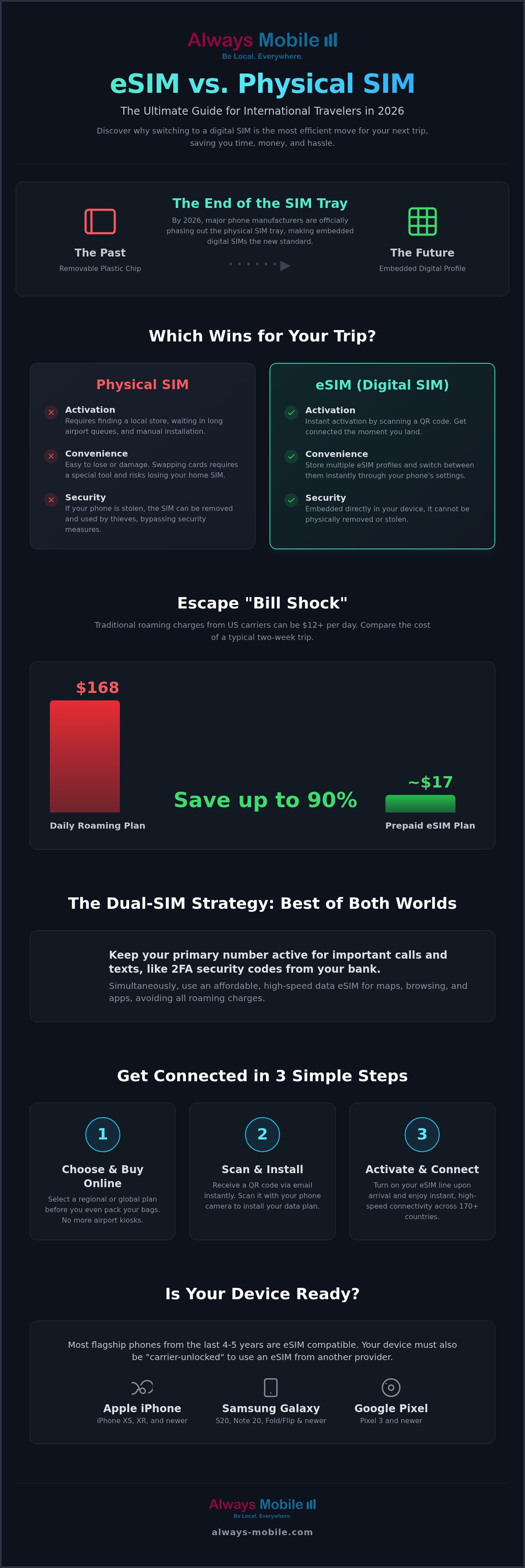
By the end of 2026, the physical SIM tray is officially becoming a relic of the past as major manufacturers shift toward all-digital designs. Landing in a foreign city should feel like an adventure, not a frantic search for a paperclip and a tiny piece of plastic. When weighing the benefits of an esim vs physical sim for international travel, the choice usually comes down to one simple question. Do you want to spend your first hour abroad in a crowded phone shop or exploring the local streets?
It's exhausting to deal with "bill shock" from $12 daily roaming charges or the stress of losing your home SIM card while swapping it on a cramped tray table. You deserve a connection that's both immediate and affordable. This comparison reveals why switching to a digital SIM is the most efficient move for your next trip. You'll discover how to save up to 90% on data costs while keeping your original number active for those essential banking 2FA codes. We'll break down the latest costs, security benefits, and exactly how to bypass the airport kiosk for good.
Key Takeaways
- Understand the shift from removable plastic to embedded chips and why modern hardware manufacturers are phase-out the traditional SIM tray.
- Evaluate the total cost of an esim vs physical sim for international travel to bypass expensive roaming bills and avoid long airport kiosks queues.
- Discover the dual-SIM strategy that allows you to keep your home number active for 2FA security codes while using affordable local data.
- Verify your device compatibility with our updated 2026 hardware list for iPhone, Samsung Galaxy, and Google Pixel models.
- Learn how regional and global plans provide instant connectivity across 170+ countries with a simple QR code scan.
Table of Contents
Understanding the Tech: eSIM vs Physical SIM Explained
For decades, the physical SIM was the only way to stay connected. It is a small, removable plastic chip that stores your unique subscriber data and links your device to a specific network. To switch carriers, you had to physically remove the card and replace it with another. This manual process is slow, prone to error, and requires a specialized tool just to open the slot. In the fast-paced world of 2026, these physical barriers are disappearing.
The eSIM represents a total shift in hardware design. Instead of a removable card, the chip is soldered directly onto your phone's motherboard. It is a programmable component that handles digital profiles instead of physical ones. When comparing the esim vs physical sim for international travel, the main difference is flexibility. One is a static piece of plastic; the other is a dynamic, digital tool that you can update instantly from anywhere in the world.
What is an eSIM Card?
An eSIM is a non-removable, digital-first connectivity standard that lives inside your device. This chip is entirely reprogrammable, allowing you to download and activate new network profiles without ever visiting a retail store. For those interested in the technical framework, you can find eSIM technology explained through the latest GSMA standards. This digital shift is the foundation of What is an eSIM Card? and why it has become the primary choice for modern travelers.
The Death of the Plastic SIM
The transition away from physical SIM cards is driven by efficiency. Manufacturers are reclaiming the internal space once occupied by the SIM tray. By removing this mechanical component, engineers can fit larger batteries or improve water resistance ratings. This hardware optimization is why the newest flagships in 2026 have ditched the tray entirely. There is also a significant environmental benefit. Digital profiles eliminate the need for millions of plastic cards and their bulky packaging.
From a traveler's perspective, the physical SIM is a liability. It is easy to lose, difficult to handle on a moving train, and requires you to find a local vendor upon arrival. The eSIM removes these friction points. You manage everything through your phone's settings. It is a no-nonsense solution that values your time. You no longer need to carry a paperclip or worry about a tiny chip falling into a floor vent. The digital profile is secure, efficient, and ready the moment you land.
The Pros and Cons: Which Wins for Your Trip?
Deciding between an esim vs physical sim for international travel is a tactical choice that defines your first hour in a new country. Traditional travelers often default to the airport kiosk. They wait in long lines, present passports to strangers, and faff with tiny metal tools. Modern travelers choose a different path. They buy their data before they even leave for the airport. This digital-first approach eliminates the "landing lag" and gets you connected to local maps and ride-share apps the moment your plane touches the tarmac.
Security is a major factor in this comparison. A physical SIM is a liability because it can be removed if your phone is stolen, allowing thieves to bypass security or use your data. In contrast, an eSIM is embedded. It cannot be physically swapped or discarded. Apple highlights these security benefits and the ease of traveling internationally with an eSIM, noting that you can store multiple profiles on a single device. You can switch between a local plan in France and a regional plan for the rest of Europe with a few taps in your settings. Stop carrying a wallet full of plastic chips and start managing your connectivity digitally.
The Advantages of Going Digital
Efficiency is the primary win. You skip the language barrier at foreign retail shops and avoid the aggressive markups common at airport tourist traps. US carriers often charge $12 per day for international roaming. Over a two-week trip, that is $168. You can save up to 90% of that cost by using a prepaid digital plan. You get immediate access to premium 4G and 5G networks without the "bill shock" later. If your journey covers multiple borders, consider regional eSIM plans to maintain a single connection across an entire continent.
Potential Drawbacks to Consider
The esim vs physical sim for international travel debate does have some technical caveats. First, your hardware must be compatible. While most flagships from the last four years support eSIM, older budget models might not. Second, your device must be "carrier unlocked." If you are still paying off your phone through a monthly contract, your provider may have blocked the use of other SIMs. Check this before you fly to avoid activation issues.
A common gap in travel advice is the "data-only" distinction. Most travel eSIMs provide high-speed data but do not include a local phone number for traditional voice calls or SMS. In 2026, this is rarely a problem. Apps like WhatsApp, iMessage, and FaceTime handle your communication needs perfectly using your data connection. You keep your home number active for essential bank 2FA codes while using the eSIM for everything else. It is the smartest way to balance cost and functionality. For a seamless experience, browse prepaid data options that fit your specific destination and duration.
The Dual-SIM Strategy: Keeping Your Home Number Active
One of the biggest mistakes travelers make is removing their home SIM card entirely. In 2026, you don't have to choose between your home identity and affordable travel data. Dual-SIM technology allows your smartphone to connect to two different networks at the same time. This setup is the gold standard for anyone comparing an esim vs physical sim for international travel. You get the reliability of your home carrier for essential services and the low-cost efficiency of a dedicated travel plan.
Security is the primary reason to keep your home line active. Most banks and secure apps require Two-Factor Authentication (2FA) via SMS to verify your identity. If your home SIM is tucked away in a drawer or lost in your luggage, you are effectively locked out of your accounts. By running a digital data plan alongside your physical home SIM, those verification codes still arrive instantly. You stay secure and connected without paying for expensive international data roaming packages.
Maintaining Your Digital Identity
Keep your existing WhatsApp and iMessage accounts linked to your home number. When you activate a travel eSIM, your phone will ask which number to use for these services. Always select your original home number. This ensures your contacts can still reach you without you having to broadcast a new, temporary foreign number to everyone you know. It is a seamless transition that preserves your digital footprint.
Configuration is key to avoiding "bill shock." Set your home line to "Primary" for calls and SMS, but set your travel eSIM as the "Secondary" line for cellular data. Most importantly, go into your settings and turn off "Data Roaming" for your home line specifically. This simple step prevents your home carrier from charging you predatory pay-per-use rates. Your phone will intelligently route all heavy data usage through your affordable travel plan while keeping your home line on standby for texts.
Managing Multiple eSIM Profiles
Modern flagships are incredibly capable. You can store eight or more digital profiles on your device at once. This is perfect for multi-country itineraries. If you are trekking through Europe or Asia, you can switch between different regional eSIM plans as you cross borders. Use the labeling feature in your cellular settings to name each SIM. Labels like "Home," "Work," or "London Trip" make it impossible to mix up your data sources. It is a streamlined, professional way to manage your global connectivity without ever touching a SIM tool.
Hardware Check: Is Your Phone Ready for the Switch?
Hardware compatibility is the final gatekeeper. You've planned your itinerary and picked your data plan. Now, you must ensure your device can actually support the technology. The debate between an esim vs physical sim for international travel is moot if your smartphone lacks the necessary internal chip. Fortunately, most flagship devices released in the last few years are already equipped for a digital-first world.
The quickest way to verify compatibility is to look for an EID number. This "Embedded Identity Document" is the unique serial number for the eSIM chip inside your phone. If your device has an EID, it can store digital profiles. However, there is one critical catch. Your phone must be "carrier unlocked." If you are still under a payment plan with a provider, they may have locked the device to their network. Contact your carrier to confirm your status before you attempt to install a travel plan.
How to Verify Your Device
Checking your status takes less than thirty seconds. Follow these steps to confirm your hardware is ready for an instant connection.
-
For iOS users: Open Settings, tap General, and select About. Scroll down to the "Available SIM" or "Digital SIM" section. If you see an EID number, you're ready.
-
For Android users: Open Settings, tap About Phone, and select Status. Look for "EID Information" or "SIM Status."
If you're unsure about a specific model, check the Always Mobile Device Compatibility list for a full breakdown of supported hardware from 2026 and earlier.
The Rise of eSIM-Only Devices
The physical SIM tray is officially on its way out. Starting with the iPhone 14 in the US, Apple removed the tray entirely, a trend that continued with the iPhone 15 and 16. Many Android manufacturers are now following suit with their premium flagships. This shift makes esim vs physical sim for international travel a simple choice. For many modern travelers, digital is the only option.
If you are using an older device that lacks this chip, you don't have to settle for high roaming fees. Some travelers use a portable travel router as a bridge, but upgrading to a modern, eSIM-capable device is the most efficient long-term solution. The industry is moving toward a tray-less future because it allows for better water resistance and larger batteries. Don't get left behind with legacy hardware. Check our latest plans and see how a modern device simplifies your global connectivity.
Why Always Mobile is the Smart Traveler's Choice
Landing in a new country should be the start of an adventure, not a scavenger hunt for a plastic chip. Always Mobile removes the friction of traditional connectivity. When you evaluate the esim vs physical sim for international travel, the winner is the one that respects your time. We deliver your connection the second you click purchase. You receive a QR code in your inbox instantly. Scan it, activate it, and you're online before the plane even reaches the gate. It is a no-nonsense approach for the modern traveler.
Transparency is at the core of our service. We offer Local eSIM plans for over 170 countries, ensuring you have local network access wherever you land. Because our plans are entirely prepaid, you never have to worry about "bill shock" or hidden roaming fees. You pay for your data upfront. You use it. You move on. It is a predictable, low-cost way to manage your digital life while abroad without the stress of a surprise charge on your next credit card statement.
Connectivity That Moves With You
Travelers rarely stay in one spot. If your itinerary involves crossing borders, you need a connection that can keep up. Our regional plans allow you to move through entire continents with a single digital profile. You won't have to swap cards or reconfigure settings as you move from France to Italy or Thailand to Vietnam. We partner with top-tier local 4G and 5G carriers to ensure you have the fastest speeds available in the region. For those on a multi-continent journey, our Global eSIM plans provide a unified, professional solution for world travelers. It is high-speed access that actually moves with you.
Support When You Need It
Simplicity is our priority. Installation is a straightforward process that requires no technical degree. We provide clear, sequential steps to get you online in minutes. If your data needs change mid-trip, our system is built for speed. You can top up your plan in seconds through our website without needing to find a local shop or speak a foreign language. We value your time and focus on utility. Don't let legacy hardware slow you down or inflate your travel budget. Get your travel eSIM today and experience the most efficient way to stay connected in 2026.
Upgrade Your Travel Strategy for 2026
The era of hunting for plastic chips in foreign airports is over. Choosing an esim vs physical sim for international travel is about more than just convenience; it is about security and cost-efficiency. By embracing digital profiles, you protect your device from SIM-swapping and maintain access to critical 2FA codes on your home line. You get the freedom to cross borders without ever losing your high-speed connection.
Always Mobile is here to ensure your journey is seamless. With a 4.8/5 star traveler rating, we provide the reliable, no-nonsense data you need to explore the world. Skip the airport queues and get your travel eSIM now. You will receive instant delivery via email and benefit from our 24/7 global connectivity support. Pack your bags, leave the roaming bills behind, and enjoy the relief of instant connectivity the moment you land.
Frequently Asked Questions
Is it better to get an eSIM or a physical SIM for international travel?
An eSIM is generally the superior choice for modern travelers due to its instant activation and cost-effectiveness. When comparing an esim vs physical sim for international travel, the digital option wins on speed. You avoid airport queues and physical swapping. However, a physical SIM might still be necessary if you use an older device that lacks the internal chip required for digital profiles.
Will I lose my WhatsApp number if I use a travel eSIM?
You won't lose your WhatsApp number or account history. WhatsApp identifies you by the phone number used during registration, not the active data stream. When you install a travel eSIM, simply select "keep existing number" within the app settings. This allows you to message contacts using your familiar identity while the eSIM provides the high-speed data needed to send those messages.
Can I use an eSIM if my phone is locked to a carrier?
No, you cannot use an eSIM if your device is locked to a specific carrier. A locked phone is restricted to its original network's software. Before purchasing a plan, contact your provider to ensure your device is "carrier unlocked." This is common for phones still under a monthly payment contract. Once unlocked, your phone can accept any digital profile from a secondary provider.
Do travel eSIMs come with a phone number for calls?
Most travel eSIMs are data-only and don't include a traditional phone number for cellular calls or SMS. This is a tactical choice to keep costs low. You can still make calls using data-based apps like FaceTime, WhatsApp, or Skype. If you need to receive bank 2FA codes, keep your home physical SIM active on standby while using the eSIM for all data-heavy tasks.
How do I install an eSIM on my phone before I travel?
Installation is a simple three-step process that you should complete before departure. First, receive your unique QR code via email immediately after purchase. Second, go to your phone's cellular settings and select "Add eSIM." Finally, scan the QR code and follow the on-screen prompts to label your new plan. It's efficient and requires no specialized technical knowledge or tools.
Can I use my physical SIM and an eSIM at the same time?
Yes, you can use both simultaneously through Dual-SIM technology. This is the most effective way to manage your esim vs physical sim for international travel needs. Set your physical SIM to handle incoming texts and calls from home while your eSIM provides affordable local data. Your phone will intelligently manage both connections, ensuring you stay reachable without incurring high roaming fees.
What happens to my eSIM after the data plan expires?
Once your data plan expires or your trip ends, the eSIM profile remains on your device but becomes inactive. You can choose to delete it in your cellular settings or keep it for future top-ups. If you plan to return to the same region, keeping the profile can make reactivation faster. Most travelers simply delete the expired profile to keep their settings menu organized and clean.
Are eSIMs safer than physical SIM cards for travelers?
eSIMs are significantly safer than physical SIM cards for international travelers. Because the chip is embedded in the motherboard, it can't be physically removed or stolen if your phone is lost. This prevents thieves from swapping your SIM into another device to bypass security. It also eliminates the risk of losing your tiny home SIM card while fumbling with a tray tool in a crowded airport.