

Did you know that major US carriers charge $2.05 per megabyte for pay-per-use data? That adds up to a staggering $2,050 for a single gigabyte. It's no wonder over 80% of American travelers feel confused and anxious about their mobile bills when they return home. You shouldn't have to fear "bill shock" just because you want to check a map or send a photo. Learning how to avoid international roaming charges is the best way to ensure your trip stays stress-free and affordable.
We understand the frustration of navigating complex carrier plans and confusing daily passes. You want to stay connected without the technical headache. This guide promises to show you exactly how to lock down your phone settings and use modern eSIM technology to eliminate surprise fees forever. You'll keep your primary number active for important messages while enjoying cheap, high-speed data. We'll walk through a clear checklist of settings to change and explain how to secure low-cost 4G or 5G access the moment you land. Let's get your phone ready for the world.
Key Takeaways
- Learn how to use Airplane Mode and system-level toggles to prevent background apps from leaking expensive data.
- Master exactly how to avoid international roaming charges by separating your digital identity from your data usage.
- Discover why modern eSIM technology outperforms risky public Wi-Fi and the physical inconvenience of local SIM cards.
- Keep your primary number active for important messages while routing all data through a low-cost travel plan.
- Access seamless global connectivity with prepaid, data-only plans that activate instantly upon arrival.
##Table of Contents
##Why International Roaming Charges Are So High in 2026
To understand how to avoid international roaming charges, you first need to know what you're up against. At its core, what mobile roaming is involves your device connecting to a foreign network to bridge back to your home carrier. This connection relies on a complex "inter-carrier fee" structure. Your home provider pays the local network a wholesale rate for every bit of data you use. They then pass that cost to you with a massive markup. These profit margins are a major revenue stream for big telecommunications companies.
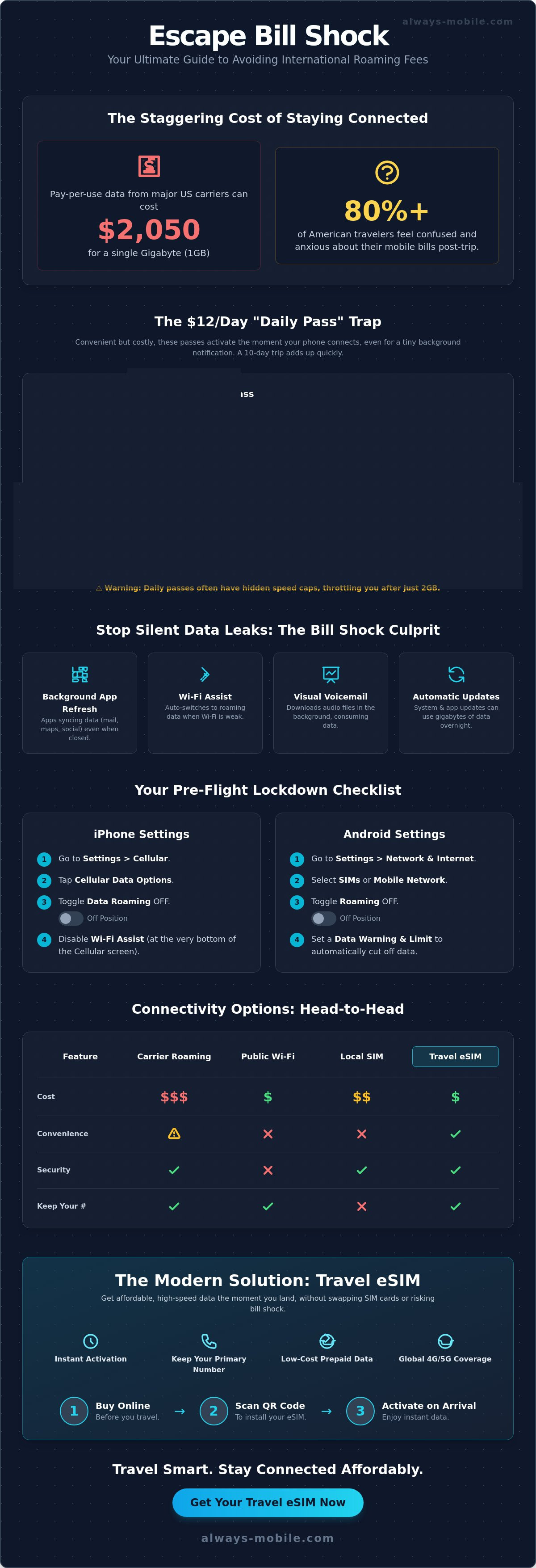
In 2026, carriers have moved toward mandatory "Daily Passes." These plans activate the moment your phone pings a tower. Even if you only use 1KB of data for a background notification, you're billed for the full day. This "pay-to-play" model has replaced older pay-per-use rates for many travelers. It makes accidental connections extremely expensive. Just keeping your phone on in your pocket could cost you hundreds of dollars by the time you fly home.
The "Daily Pass" Trap
Major US carriers like AT&T and Verizon now charge $12 per day for international access. While this feels convenient, it's a financial drain. A 10-day trip costs $120 in fees alone. Compare that to a local data plan, which often costs a fraction of that for the entire duration. These "unlimited" daily passes aren't always what they seem. Many come with hidden speed caps. For example, Verizon's TravelPass throttles speeds after 2GB of usage. You pay a premium for a connection that might fail you when you need it most.
Silent Data Leaks: The Bill Shock Culprit
Your phone is designed to stay connected, which is a liability abroad. Several "hidden" triggers can activate roaming charges without you ever opening an app. These silent leaks are the primary cause of "bill shock."
-
Background App Refresh: Apps like Maps, Mail, and Social Media constantly sync data to provide real-time updates.
-
Wi-Fi Assist: This feature, sometimes called "Network Boost," automatically switches you to roaming data if the local Wi-Fi signal is weak.
-
Visual Voicemail: Your phone downloads audio files for voicemails in the background, consuming data instantly.
-
Automatic Updates: System and app updates can trigger gigabytes of data usage while you sleep.
Even receiving a "Welcome" SMS from a local provider can occasionally trigger a daily fee if your phone responds with a delivery receipt. Knowing these triggers is the first step in learning how to avoid international roaming charges effectively. You have to be proactive to keep your bill at zero.
##Immediate Steps: Phone Settings to Stop Data Leaks
Your phone is a data-hungry machine. Even while it sits in your pocket, dozens of apps are communicating with satellites and local towers. This is the first step in how to avoid international roaming charges. You must stop the silent data leaks before they start. Many travelers assume that simply staying off their browser is enough. It isn't. You need to proactively avoid roaming charges overseas by locking down your device's hidden communication channels.
The "Nuclear Option" is Airplane Mode. Turn it on the moment you board your flight. This kills all cellular signals instantly. You can then manually re-enable Wi-Fi to use airport or hotel networks. While effective, this keeps you disconnected from cellular data entirely. To maintain a connection without the cost, you need to dive into your system settings. In 2026, many devices support 5G Standalone roaming, which can sometimes bypass traditional data-saving toggles if your OS isn't updated. This guide on how to avoid international roaming charges requires a hands-on approach to your device's OS.
iPhone Settings for International Travel
Open Settings and tap Cellular. Select Cellular Data Options and toggle Roaming OFF. This is your primary defense. Disable "Low Data Mode" if you want to manually control which apps sync in the background. To monitor your consumption, scroll to the bottom of the Cellular menu to find the "Reset Statistics" button and tap it the moment you land to start a clean log of your usage.
Android Settings for Global Trips
Navigate to Network & Internet and select Mobile Network. Disable "Roaming" immediately. Use the "Data Warning" and "Data Limit" features to set a hard cap on your usage. This kills the connection automatically before you hit expensive overages. Don't forget messaging apps. Open WhatsApp and Telegram settings to disable "Auto-download" for media, ensuring photos and videos only load when you're on a trusted connection.
Watch out for "Wi-Fi Assist" on iOS or "Adaptive Wi-Fi" on Android. These features are designed to be helpful. If your Wi-Fi signal is weak, your phone automatically switches to cellular data to maintain speed. Abroad, this means your phone might jump onto a roaming network without warning. Toggle these off in your cellular or network settings to stay in control. If you prefer a more automated approach, exploring prepaid eSIM plans can provide a dedicated data lane that won't touch your home carrier's bill.
Finally, manage your Background App Refresh. This feature allows apps like Instagram and Mail to check for new content every few minutes. Turn it off entirely or restrict it to "Wi-Fi Only." This prevents your phone from using expensive roaming data to update a social media feed you aren't even looking at.
##Comparing Your Options: eSIM vs. Local SIM vs. Wi-Fi
Once your settings are locked, you need a reliable data source. Choosing the right connection method is the final piece of the puzzle regarding how to avoid international roaming charges. You generally have three choices: hunting for Wi-Fi, buying a physical SIM, or using a modern eSIM. Each has its own impact on your budget and your sanity.
Don't fall for the "Free Wi-Fi" myth. It feels like a bargain until you're standing on a rainy street corner trying to connect to a weak coffee shop signal. It's frustrating and often insecure. Public Wi-Fi networks are frequently unencrypted, leaving your passwords and banking details vulnerable to hackers. It’s a high-stress, low-reliability way to navigate a foreign country.
Physical local SIMs are the old-school alternative. They offer cheap data, but they require a significant trade-off in convenience. You have to find a physical store, wait in line, and often provide your passport for registration. Then comes the "SIM swap." You remove your primary card, risk losing that tiny piece of plastic, and lose access to your home phone number. It's a clunky, analog solution for a digital world.
Travel eSIMs have become the modern standard for frequent flyers. They offer instant activation without any hardware swaps. International carrier plans, by contrast, remain the most expensive route. They might work for a quick 24-hour layover, but for anything longer, they are a financial trap. A prepaid eSIM lets you maintain your primary identity for iMessage or WhatsApp while routing all heavy data through a cheap, dedicated lane. It’s the most efficient way to stay online.
Why Digital SIM Cards Are Replacing Physical SIMs
Modern hardware is moving away from physical slots entirely. Learning what is an esim card helps you leverage your phone's full potential. You can store multiple profiles on one device. Switch between a local plan and a regional plan with a single tap in your settings. This flexibility is perfect for multi-country trips. It also removes the need for plastic SIM production, making your travels a bit more sustainable.
Prepaid vs. Postpaid Travel Data
Postpaid carrier plans are the primary cause of bill shock. You use data first and hope the bill isn't astronomical. Prepaid models, like those used for how to avoid international roaming charges, offer total control. You pay a set amount upfront. There are no hidden fees or surprise overages. If you run low, you top up your data on the fly through an app without visiting a kiosk. It’s transparent, simple, and provides immediate psychological relief. You know exactly what you've spent before you even board your flight home.
##How to Set Up a Travel eSIM Without Losing Your Number
Setting up a digital data plan is faster than waiting in a customs line. Most travelers assume this process is reserved for tech experts, but it's a simple three-minute task. If your phone was manufactured after 2020, it likely supports this technology. This is the most effective strategy for how to avoid international roaming charges while keeping your digital life intact. You don't need to visit a store or swap physical hardware. Everything happens through your screen.
Check that your iPhone or Android device is eSIM-compatible. You can check your phone against our Device Compatibility list .
Start by purchasing your plan online before you depart. You'll receive a QR code in your email instantly. Scan this code while you're still on your home Wi-Fi or at the airport terminal. This installs a secondary cellular profile on your device. Once you land, you simply toggle this new line on. Your phone will immediately hunt for a local 4G or 5G signal. It's immediate. It's efficient. It removes the stress of being disconnected the moment you step off the plane.
The Dual-SIM Strategy: Keeping Your WhatsApp Active
The "Best of Both Worlds" approach allows you to separate your identity from your data. Configure your phone to use the eSIM for all "Cellular Data" needs. Simultaneously, keep your Primary SIM set for "Voice and SMS." This configuration is the secret to how to avoid international roaming charges without losing access to your home number. Your iMessage and WhatsApp accounts stay linked to your original digits. Friends and family can still reach you. Just ensure your home carrier's "Data Roaming" toggle is strictly OFF. Meanwhile, keep "Data Roaming" ON for your travel plan. Always Mobile provides local esim plans that activate the moment you land, ensuring you never miss a beat.
Managing Regional and Global Itineraries
If your trip spans multiple borders, don't waste time buying individual plans for every country. Use regional esim plans for Euro-trips or Asian tours. These "borderless" data profiles work seamlessly across 30 or more countries. You can travel from France to Italy without ever touching your settings. The data just works. For those visiting multiple continents, your phone can store several eSIM profiles at once. Switching between them takes seconds. You simply select the plan you need for your current location and get back to your trip.
Ready to secure your connection? Get your prepaid travel data today and eliminate roaming fees forever.
##Get Seamless Global Data with Always Mobile
Choosing the right provider is the final step in your journey to master how to avoid international roaming charges. Always Mobile is a specialist in low-cost, prepaid travel data. We adopt a strict no-nonsense approach. Our plans are data-only. This means they just work. You won't find complicated voice packages or hidden SMS fees here. We provide reliable coverage in over 170 countries. Activation is instantaneous via a digital QR code. It’s the smarter, more agile alternative to traditional carrier systems.
Security and reliability are at the core of our service. You have the peace of mind that comes with 24/7 digital support. If you run low on data while exploring a new city, topping up is effortless. You don't need to find a physical kiosk or wait on hold with a domestic carrier. You simply add more data through our digital platform and keep moving. This transparency ensures that you stay in total control of your travel budget from start to finish. It's about removing friction from your digital experience.
Choose the Right Plan for Your Trip
Every traveler has different needs. That's why we offer a variety of tailored options. You can select Local eSIM Plans if you're staying in one country. If your itinerary includes multiple stops, our Regional eSIM Plans cover entire continents with a single profile. For those on extended journeys across different zones, our global esim options provide seamless connectivity. We also offer Daily Unlimited eSIM Plans for heavy users. These are perfect for streaming, video calls, or working remotely. Our pricing is transparent. You'll never deal with the "Day Pass" surprises or hidden fees that home carriers often impose.
Ready to Travel Smarter?
The savings are clear. Paying for your data upfront is the most effective way to manage your costs. It's significantly cheaper than traditional roaming. You gain immediate connectivity the moment your plane's wheels touch the tarmac. No hunting for Wi-Fi. No swapping physical SIM cards. You keep your primary number for messages and use our dedicated data lane for everything else. It’s the ultimate strategy for how to avoid international roaming charges while staying fully connected to what matters. Don't let your next trip be ruined by a massive phone bill. Browse Always Mobile eSIM plans for your next destination and experience a stress-free digital journey.
##Master Your Mobile Connectivity
Navigating the world doesn't have to mean sacrificing your budget to high carrier fees. You now have the blueprint for how to avoid international roaming charges by locking down your system settings and embracing digital SIM technology. By disabling silent data leaks and using a Dual-SIM strategy, you maintain your primary number for essential messages while routing data through a dedicated, low-cost lane. It's a modern solution that puts you back in the driver's seat.
Always Mobile removes the traditional barriers to global connectivity. We provide instant activation in over 170 countries and access to local 4G or 5G networks. This means you can stay online the second you land. Our prepaid plans ensure there are no hidden fees or surprise daily pass charges ever. You pay for exactly what you need and nothing more.
Stop Roaming Charges—Get Your Always Mobile eSIM Now. Your next adventure is waiting. Travel with confidence and stay connected on your own terms.
##Frequently Asked Questions
Will I get charged for roaming if I only use Wi-Fi?
You won't be charged for data roaming as long as your cellular data toggle is switched off. However, your phone might still try to connect if features like Wi-Fi Assist or Adaptive Wi-Fi are active. Always disable these "boost" settings in your cellular menu to ensure your phone doesn't jump onto a roaming network when the Wi-Fi signal drops.
Do I need to turn off my primary SIM card when using an eSIM?
Keep your primary SIM active to receive important calls or texts. You simply need to go into your settings and designate the eSIM as your only source for cellular data. This is the most efficient way to maintain your home identity while following our guide on how to avoid international roaming charges. Your phone handles both lines simultaneously without conflict.
Can I still receive text messages (SMS) without roaming charges?
Most major carriers allow you to receive incoming text messages for free while abroad, but sending them usually triggers a fee. Check your specific home plan before you depart to confirm their policy. To be safe, use data-based apps like WhatsApp or iMessage for all outgoing communication to keep your home carrier bill at zero.
How much data do I actually need for a one-week trip?
A typical traveler uses between 3GB and 5GB of data per week for navigation, social media, and basic browsing. If you plan on streaming high-definition video or making frequent video calls, you'll need significantly more. Start with a 5GB plan and use the top-up feature if your usage increases during your stay.
What happens if I run out of data while I am abroad?
Your data connection will simply stop working once you hit your limit. You won't face surprise overage fees because these plans are prepaid. For customers with fixed-data eSIM plans, you can instantly purchase more data through your digital account to get back online. It’s a transparent system that keeps you in total control of your spending.
Is an eSIM better than buying a local SIM at the airport?
An eSIM is superior for several reasons. You don't have to wait in long airport lines or hand over your passport for registration. It also eliminates the risk of losing your physical home SIM card during a swap. You get immediate connectivity the moment you land without the analog hassle of physical stores.
Will using an eSIM change my WhatsApp or iMessage number?
Your WhatsApp and iMessage accounts remain linked to your primary phone number. The eSIM only provides the data lane that these apps use to communicate. You can continue chatting with your existing contacts exactly as you do at home. There is no need to update your contact info or re-verify your account.
Does Airplane Mode completely stop all roaming charges?
Airplane Mode is a foolproof way to stop all cellular communication and is a key tactic for how to avoid international roaming charges. It shuts down your phone's ability to ping local towers entirely. You can still manually enable Wi-Fi while in Airplane Mode to browse the web safely using trusted local networks.