

Over 51% of eSIM users first adopted the technology specifically for international travel. It's a logical shift. You shouldn't have to spend your first hour in a new country hunting for a physical SIM card kiosk or deciphering registration forms in a foreign language. Learning how to get data in asia has evolved from a stressful logistical hurdle into a simple digital setup you finish before your flight even departs.
It's frustrating to deal with the constant anxiety of being disconnected or the looming fear of a massive roaming bill from your home carrier. You want a solution that just works the moment you land. This guide will help you master the art of staying connected across the continent while avoiding common roaming traps. We'll explore how to secure instant 5G connectivity in hubs like Japan, South Korea, and Singapore using regional eSIM plans that offer transparent, prepaid pricing with no hidden fees.
Key Takeaways
- Discover how to get data in asia using digital-first solutions that bypass physical SIM cards and registration lines.
- Avoid expensive roaming traps by switching to transparent, prepaid eSIM plans that provide instant 5G connectivity upon arrival.
- Master the difference between local, regional, and global plans to find the most cost-effective coverage for your specific itinerary.
- Learn how to install and activate your data plan in minutes with a simple QR code sent directly to your email.
- Decide between fixed data buckets and daily unlimited plans to ensure you never run out of signal while navigating new cities.
Table of Contents
-
Navigating Data Options in Asia: Roaming, Physical SIMs, and eSIMs
-
Choosing Your Coverage Strategy: Local vs. Regional vs. Global eSIMs
-
Fixed Data vs. Daily Unlimited: Which Plan Fits Your Travel Style?
-
Why Always Mobile is the Smart Choice for Asia Travel in 2026
Navigating Data Options in Asia: Roaming, Physical SIMs, and eSIMs
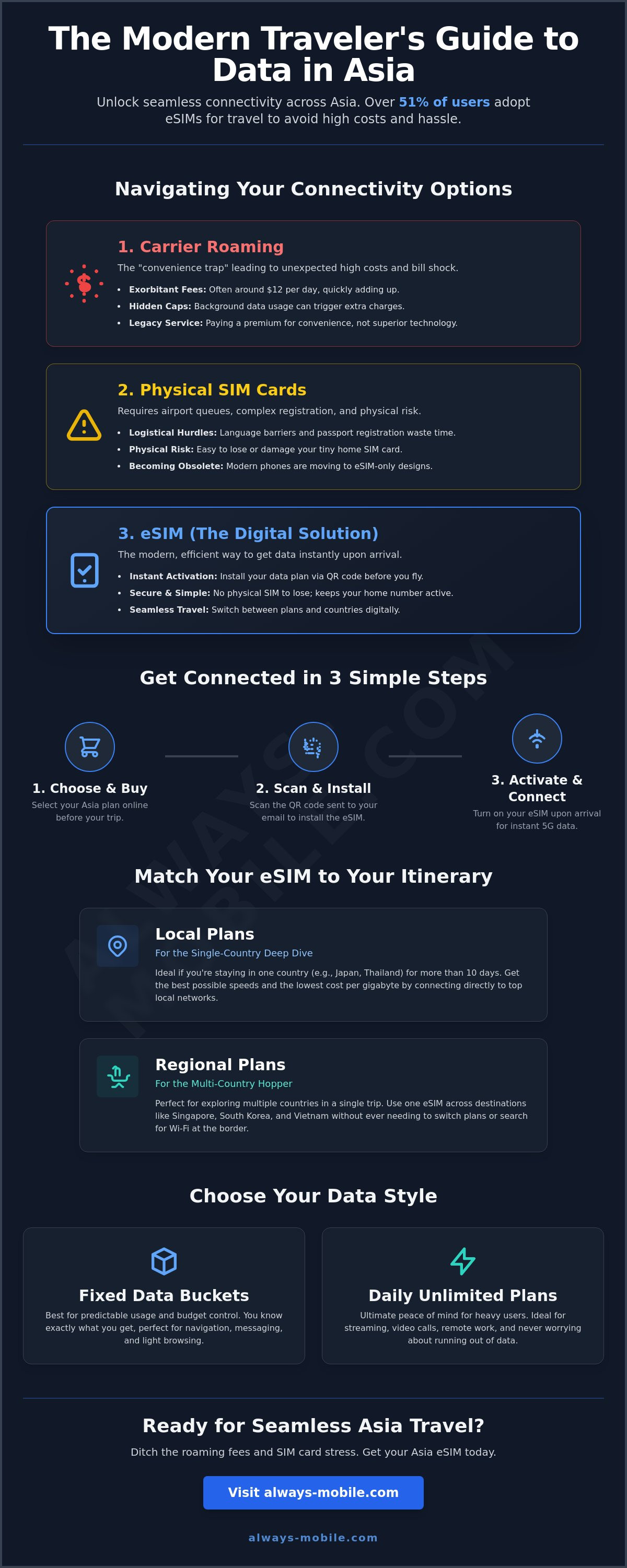
Asia's digital terrain is a study in contrasts. You can find hyper-fast 5G networks in the dense skyscrapers of Seoul or Singapore; however, the signal might drop to a basic 3G connection while trekking through remote parts of the Philippines or Vietnam. Understanding how to get data in asia is no longer just about finding a signal. It's about choosing an infrastructure that matches your travel pace. Most travelers still rely on outdated methods that lead to unnecessary stress and high costs.
The traditional way to stay connected involved two choices: pay your home carrier's exorbitant fees or hunt for a local plastic chip at an airport kiosk. Neither is ideal for a modern itinerary. International roaming is essentially a legacy service with massive price markups, while physical SIM cards introduce hardware risks that can disrupt your entire trip. The shift toward digital-first connectivity is driven by a need for speed, security, and simplicity.
The Hidden Costs of Carrier Roaming
Many travelers fall into the "convenience trap" of carrier roaming. US-based carriers often offer a "Daily Pass" for around $12 per day. While this sounds manageable, it quickly becomes a financial burden on a two-week trip across Asia. You aren't paying for better service; you're paying for the convenience of not changing your settings. This often results in "bill shock" upon your return, as hidden data caps or background app refreshes can trigger additional fees. Roaming remains a high-margin product for carriers that relies on traveler anxiety rather than technical superiority.
Physical SIM Cards: The Logistics of Swapping
The "airport booth" experience is another common hurdle. Purchasing a local physical SIM card requires you to navigate language barriers and strict local regulations. In countries like Thailand, you must provide your passport for registration, and some vendors may even require biometric data. This takes time you could spend exploring.
There is also the physical risk. Swapping cards means handling a tiny piece of plastic that is easily lost or damaged. If you lose your primary home SIM card while abroad, you lose access to two-factor authentication codes and important banking alerts. As modern smartphones move toward dual-SIM and eSIM-only designs, these plastic chips are rapidly becoming obsolete.
The Rise of the Digital SIM
Savvy travelers are now opting for eSIM technology to bypass these traditional pain points. If you are still wondering what is an eSIM card, it is a programmable chip embedded directly into your device. It allows you to download a data profile instantly without visiting a store or opening your SIM tray. This digital approach is the most efficient way to manage how to get data in asia, offering a seamless transition between countries with zero physical waste.
Choosing Your Coverage Strategy: Local vs. Regional vs. Global eSIMs
Selecting the right data strategy depends entirely on your flight path. You don't want to pay for 20 countries if you're only visiting one; however, you also don't want to buy a new plan every time you cross a border. Figuring out how to get data in asia efficiently requires matching your digital footprint to your physical itinerary. The goal is to minimize cost while maximizing your time on the ground.
Most travelers fall into three categories: the deep-diver, the hopper, or the world traveler. Each requires a different approach to connectivity. By choosing the correct plan type before you board your flight, you eliminate the need to hunt for Wi-Fi or manage multiple physical SIM cards during your trip.
Single-Country Focus: When a Local Plan Wins
If your trip involves staying in one place for more than 10 days, a local plan is usually the smartest move. These plans provide the most direct access to local 5G networks at the lowest possible cost per gigabyte. For instance, finding the best esim thailand offers is essential for travelers spending their entire vacation in Bangkok or the islands. Local plans prioritize high-speed data buckets. They are perfect for remote work or heavy video streaming. If you're staying in a tech hub like Tokyo or Seoul, local infrastructure is built for massive data consumption. A local eSIM ensures you aren't stuck on a secondary network while locals enjoy blazing speeds.
The Regional Advantage: One eSIM, Many Borders
Travelers planning to explore multiple countries in one trip should look at regional eSIM plans. These are designed for seamless transitions. When you fly from Vietnam to Cambodia, your phone automatically detects the new network and switches. You don't have to do anything. You keep the same QR code and the same data balance across the entire region. Popular regional groupings include Southeast Asia, the Asia-Pacific corridor, and Greater China. This is the most efficient way to manage how to get data in asia when your itinerary looks like a multi-stop tour of the Mekong. It's immediate. It's invisible.
For those whose journey extends far beyond the continent, global eSIM plans provide a single solution for a world tour. It's about reducing friction. If you're visiting Japan and then flying to Europe, a global plan keeps you online without a second thought. Always choose the plan that covers your furthest destination. This prevents the data gap that happens when you step off a plane in a country your current plan doesn't support. Match your plan to your map to ensure you stay connected from takeoff to touchdown.
Fixed Data vs. Daily Unlimited: Which Plan Fits Your Travel Style?
Choosing how to get data in asia involves more than just picking a country; you must pick a consumption model. Connectivity plans generally fall into two categories: fixed data buckets and daily unlimited plans. Each serves a specific type of traveler. You don't want to run out of maps in the middle of Tokyo, but you also shouldn't pay for data you'll never use.
Fixed data plans give you a set amount of data, such as 5GB, 10GB, or 20GB, to use over a specific period. These are predictable. You pay once and monitor your usage. Daily unlimited plans reset your high-speed quota every 24 hours. They offer a safety net for those who can't afford to be offline for even a minute.
Be aware of Fair Usage Policies (FUP). Many "unlimited" plans in the Asian market aren't actually infinite at 5G speeds. They often provide a high-speed allowance, typically 1GB or 2GB per day, before throttling your speed to a lower tier. Always check the fine print to avoid a sudden slowdown during an important video call or upload. This is a critical detail that many travelers overlook until their speeds drop unexpectedly.
Estimate your needs before you buy. Google Maps uses surprisingly little data, but high-definition video calls and social media scrolling can drain a 5GB bucket in days. One hour of active social media use can consume up to 600MB. If you plan to stream music while navigating or join Zoom meetings on the go, your usage will climb quickly. Choose a plan that matches your heaviest day of usage, not your lightest.
The Casual Sightseer: Why Fixed Data is Often Enough
If you primarily use your phone for navigation, occasional Instagram posts, and messaging, fixed data is usually your best bet. A 10GB plan can easily last two weeks for a casual user. It's the most cost-effective way to manage how to get data in asia without overspending on unused capacity. If you do run low, most digital plans allow for instant top-ups through an app. You only pay for what you actually consume, making it the efficient choice for budget-conscious travelers.
The Power User: When Daily Unlimited is Essential
Daily unlimited plans are essential for those who treat their phone as a primary hotspot. If you're a digital nomad or a content creator uploading 4K reels, you need the security of a daily reset. These plans provide peace of mind in areas where hotel Wi-Fi is unreliable or non-existent. They ensure you always have a fresh start every morning regardless of how much you uploaded the night before. Daily unlimited plans are ideal for those who treat their phone as a primary hotspot and require consistent, high-speed access for professional tasks.
How to Install and Activate Your Asia Data Plan Instantly
Setting up your connection shouldn't feel like a technical chore. Mastering how to get data in asia is a matter of following a few simple steps before you ever leave home. The goal is to arrive with a working connection so you can focus on your trip, not your settings menu. Don't wait until you land to start the process. Most installation issues occur because travelers try to set up their plans using spotty airport Wi-Fi.
First, verify your phone is carrier-unlocked. If your device is still under a payment plan, your carrier might have restricted it to their network. Check this in your settings under "About" or "Network." Once confirmed, purchase your plan and wait for the QR code to arrive in your email. This code is your digital key to the local network. Scan it, and your phone will automatically configure the new line. This is the most efficient way to manage how to get data in asia without the stress of troubleshooting on the go.
Pre-Flight Preparation Checklist
Complete your installation while you are still on a stable home Wi-Fi connection. This ensures the digital profile downloads without interruption. Label your new line immediately. Use names like "Asia Travel" or "Work Data" to distinguish it from your primary SIM. This prevents you from accidentally using your home line and triggering expensive roaming fees. Finally, turn off "Data Switching" in your cellular settings. This forces your phone to stay on the travel line for all internet activity while keeping your primary line active for emergency texts only.
Troubleshooting and Optimization in Asia
If your 5G signal doesn't appear immediately upon landing, don't panic. Sometimes the network needs a manual nudge. Go to your cellular settings and ensure "Data Roaming" is toggled on for the travel line only. If speeds feel sluggish, check the APN (Access Point Name) settings. Most eSIMs configure this automatically, but some require a manual entry provided in your activation email.
Be mindful of your battery. Searching for a 5G signal in rural areas or on high-speed trains can drain your phone quickly. If you're in a remote area with inconsistent 5G, manually switch your settings to 4G/LTE. This provides a more stable connection and preserves your battery for the rest of the day. If the automatic network choice is slow, you can also manually select a different carrier from the list in your settings to find a stronger signal.
Ready to simplify your next journey? Get started today by browsing our global eSIM plans to find your perfect match for any Asian itinerary.
Why Always Mobile is the Smart Choice for Asia Travel in 2026
Modern travel requires a connection that moves as fast as you do. When you're deciding how to get data in asia, you need a partner that eliminates the friction of traditional roaming. Always Mobile provides instant delivery of 4G and 5G data across 170+ countries. This means you can purchase your plan in the terminal and have a working connection before you even reach immigration. There's no physical SIM swapping and zero plastic waste; your entire connectivity suite lives securely on your device's embedded chip.
Transparency is the foundation of our service. You won't find any contracts, credit checks, or hidden fees here. Every plan is strictly prepaid. You know exactly what you're paying for before you hit the "buy" button. For travelers whose journeys span multiple continents, our global eSIM options provide a single, powerful solution that covers your entire world tour. It's the ultimate tool for the truly adventurous who refuse to be tethered by local borders.
Reliability on Local Networks
We don't believe in second-tier service. Always Mobile provides direct access to top-tier Asian carriers. You'll connect to premium networks like AIS in Thailand and Softbank in Japan. This ensures you receive high-speed data priority even in crowded urban centers. While other travelers struggle with throttled speeds on legacy roaming plans, our users enjoy the same network quality as the locals.
Security is also a major factor in 2026. A digital-first solution is inherently safer than a physical one. You can't lose an eSIM, and it can't be stolen from your phone's tray. If you lose your device, your data profile can be quickly restored to a new one. This peace of mind is essential when you're navigating unfamiliar environments where your phone is your lifeline.
Simple Management and Top-ups
Managing your data shouldn't be a guessing game. We provide tools to track your usage in real-time. You'll always know exactly how many gigabytes you have left for your trip. If your stay in Bali gets extended or you decide to take a last-minute flight to Tokyo, our "one-click" top-up process keeps you online. You don't have to install a new eSIM or change any settings. Just add more data to your existing line and keep moving.
Stop worrying about how to get data in asia and start focusing on your destination. We've built a system that values your time and your budget. It's efficient, reliable, and designed for the way people travel today. Get your Asia eSIM from Always Mobile today and experience the relief of instant, stress-free connectivity.
Stay Connected Across Every Asian Border
Staying connected across a diverse continent shouldn't be a source of anxiety. You now have a clear roadmap for how to get data in asia without the burden of physical SIM cards or hidden roaming fees. By choosing a digital-first strategy, you gain the freedom to move across borders while maintaining a high-speed 5G connection. It's about making your technology work for you, not the other way around.
Remember to select your plan based on your specific travel style. Whether you need a local bucket for a deep dive into Japan or a regional plan for a multi-country tour, the right choice ensures you only pay for the data you actually consume. Pre-installing your eSIM before departure guarantees that you'll be online the second your plane touches the tarmac. Always Mobile offers instant 5G activation in over 170 countries and provides 24/7 digital support for travelers. You can travel with confidence knowing your connection is guaranteed and your costs are fixed.
Browse Asia eSIM Data Plans from Always Mobile and secure your high-speed access today. Your journey is waiting; stay connected every step of the way.
Frequently Asked Questions
Can I keep my WhatsApp number while using an Asia eSIM?
You can keep your WhatsApp number exactly as it is. WhatsApp links to your account and phone number through its own software; it doesn't rely on the physical SIM card currently providing your data. When you install your new plan, simply select the option to keep your current number if the app asks. You'll continue to message your existing contacts without any interruption or account changes.
Will an eSIM work in rural parts of Asia like Northern Vietnam or Bali?
Connectivity is widely available across rural Asia. Most regions in Northern Vietnam and Bali have strong 4G LTE coverage. However, 5G availability is generally concentrated in major cities. Always Mobile connects you to top-tier local carriers to ensure the best possible signal in remote areas. If the signal feels weak, try switching your phone settings to 4G/LTE to maintain a more stable connection.
Do I need to turn off my primary SIM card to use an Asia data plan?
You don't need to turn off your primary SIM card. Modern smartphones support Dual SIM technology, which allows you to keep your home line active for emergency calls or texts while using the eSIM for all data. Just ensure you turn off "Data Roaming" for your primary line in your settings. This prevents your home carrier from triggering expensive daily roaming charges while you browse.
How much data do I really need for a two-week trip to Asia?
A 10GB plan is typically sufficient for a two-week trip. This covers daily navigation, social media check-ins, and messaging. If you plan to stream high-definition video or join work calls, consider a 20GB plan or a Daily Unlimited eSIM. Monitoring your usage in real-time helps you stay within your limits. This is a key part of managing how to get data in asia efficiently without overspending.
Can I use my phone as a hotspot (tethering) with an Asia eSIM?
You can use your phone as a hotspot with any Always Mobile plan. Tethering allows you to share your data connection with laptops, tablets, or other travelers. This is particularly useful in areas with unreliable hotel Wi-Fi. Keep in mind that tethering consumes data faster than solo browsing. Choose a Daily Unlimited plan if you intend to use your phone as a primary hotspot for multiple devices.
What happens if I run out of data in the middle of my trip?
You can top up your plan Fixed Data eSIM instantly if you run out of data. There's no need to install a new eSIM profile or scan a new QR code. Simply log in to your account and add more data to your existing line. The new data bucket activates immediately so you never lose your connection. This flexibility is essential for travelers whose plans change or whose trips are extended unexpectedly. Our Daily Unlimited plans can not be topped up.
Is my iPhone or Android device compatible with Always Mobile eSIMs?
Most modern iPhone and Android devices are compatible. Generally, any iPhone released after the XS and most flagship Android phones from the last few years support eSIM technology. Your device must also be carrier-unlocked to use a third-party data plan. You can verify this in your settings menu under "About" or "Cellular." If your phone shows an "Add eSIM" option, it is ready for digital activation. You can also check our Device Compatibility list for your specific phone model.
Do I need a different eSIM for every country in Asia?
You don't need a different eSIM for every country. If you're visiting multiple nations, choose a Regional Asia eSIM . This single plan automatically switches to the best local network as you cross borders. It's the most convenient way to handle how to get data in asia for multi-stop itineraries. One QR code covers your entire journey across Southeast Asia, the Asia-Pacific region, or Greater China.