

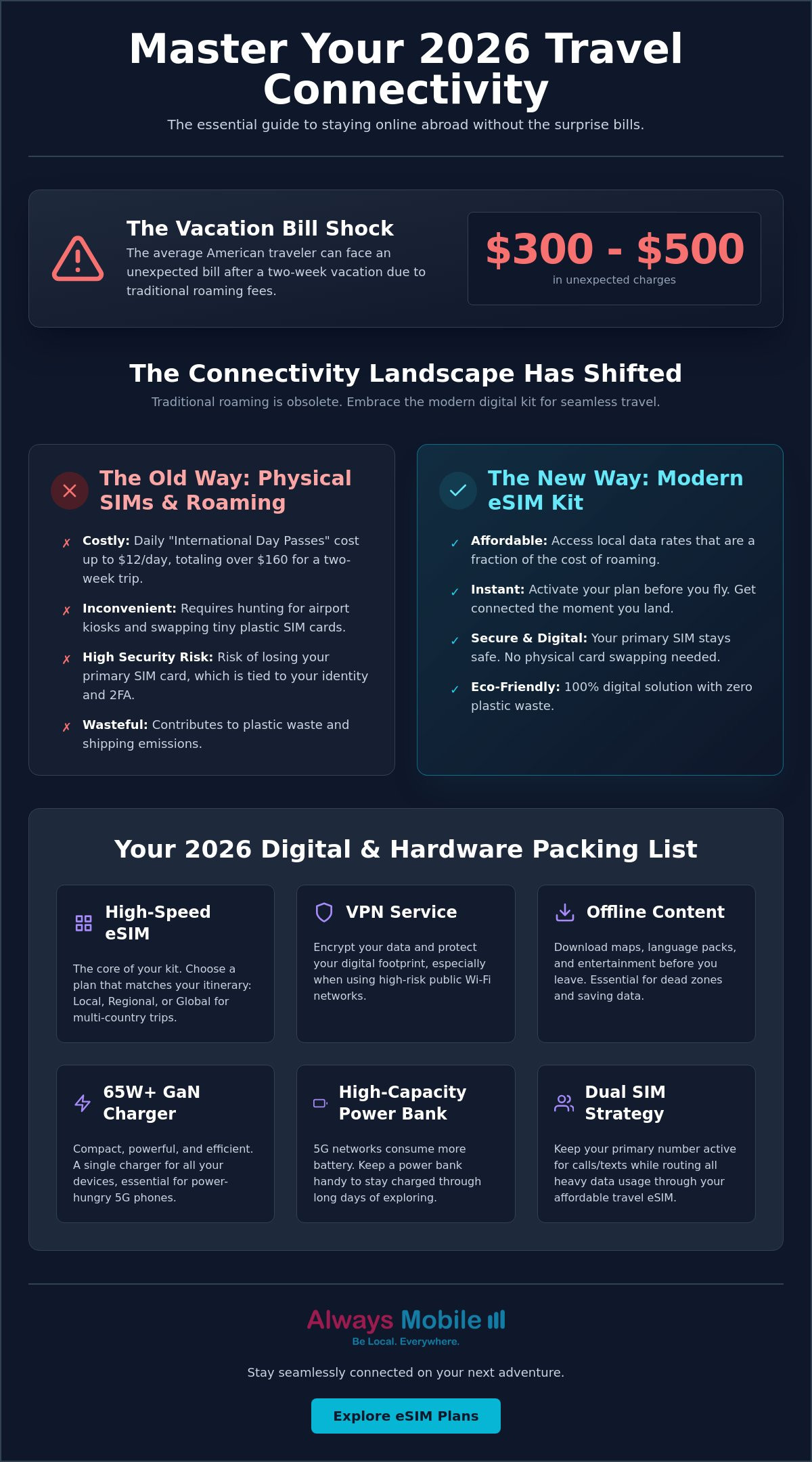
The average American traveler can face $300 to $500 in unexpected roaming charges after a two week vacation. It's a staggering financial hit that often stems from a simple lack of preparation. Understanding how to get data while traveling internationally is no longer just a convenience; it's a critical skill for the modern explorer. You shouldn't have to hunt for spotty public Wi-Fi or return home to a massive carrier bill just to stay connected or navigate a new city.
We all want the immediate relief of reliable connectivity the moment we touch down. This guide helps you master your 2026 travel connectivity by detailing the essential digital packing list, from high-speed eSIMs to the hardware that keeps them running. We'll show you how to build a lightweight tech kit that provides instant 5G access and robust digital security. From avoiding the public Wi-Fi trap to optimizing your 5G battery life, you'll gain the peace of mind to focus on your journey rather than your data cap.
Key Takeaways
- Ditch traditional roaming for a digital connectivity kit built around high-speed 5G eSIM plans.
- Discover how to get data while traveling internationally by activating your plan before takeoff for seamless connectivity the moment you land.
- Optimize your hardware with 65W GaN chargers and high-capacity power banks to support the increased energy demands of 5G networks.
- Secure your digital footprint by using a VPN to encrypt sensitive data when accessing high-risk public Wi-Fi networks.
- Keep your primary number active for messaging services while routing all heavy data usage through affordable local or regional plans.
The 2026 Connectivity Landscape: Why Traditional Roaming is Obsolete
The travel landscape has shifted. In 2026, staying connected is no longer about finding the nearest coffee shop Wi-Fi. It's about a "Modern Connectivity Kit." This kit combines eSIM technology with high-efficiency hardware to ensure you never lose a signal. Landing in a new country and figuring out how to get data while traveling internationally should be the easiest part of your trip. Traditional roaming has become a relic. Major U.S. carriers still charge up to $12 per day for international access. That totals over $160 for a two-week trip. These "International Day Passes" are budget killers designed for convenience, not value.
The Death of the Physical SIM Card
Physical SIM cards belong in the 2010s. By 2026, most flagship smartphones have moved to eSIM-only or dual-eSIM configurations. Swapping tiny pieces of plastic at a crowded airport border is a major security risk. You risk losing your primary SIM card; this card often holds your identity and two-factor authentication access. Going 100% digital is faster and more secure. Consider these benefits:
- Instant Activation: Download your profile before you even leave home.
- Zero Waste: Eliminate the need for wasteful plastic production and shipping.
- Enhanced Security: Keep your home SIM safely inside your device settings, not in a plastic baggie.
5G Ubiquity and Its Impact on Your Data Needs
5G is now the global standard. While the speed is incredible, it changes how you consume data. High-speed networks encourage your phone to download updates, sync photos, and stream in 4K automatically. A standard 1GB plan that used to last a week might now disappear in a single afternoon of GPS use and social media posting. The reality of 2026 is that 5G demands more from your plan.
When planning how to get data while traveling internationally, you need to account for this increased demand. It's essential to choose local eSIM plans that offer high daily limits or unlimited options. Low-tier data buckets are no longer sufficient for the modern traveler. To save your allowance, manage your background data usage. Turn off automatic cloud syncing for photos until you reach a secure, private network. This small step prevents 5G from draining your data while your phone is still in your pocket.
The Digital Essentials: Your 2026 Virtual Packing List
Packing for a trip in 2026 involves more than just folding clothes and checking your passport. Your virtual packing list is now just as critical for a friction-free journey. At the center of this list is the software that keeps you online without the heavy tether of a physical carrier. Moving your connectivity to the digital layer allows you to land, connect, and move through your destination with total confidence.
The core of your kit starts with understanding what is an eSIM card and how it effectively replaces traditional roaming. It's the most efficient solution for how to get data while traveling internationally. You simply download a digital profile and activate it the moment your plane touches the tarmac. This removes the stress of finding a retail kiosk or dealing with language barriers at an airport phone stand.
Don't rely solely on a live connection, though. Even with global 5G expansion, dead zones still happen. Download your Google Maps and language translation packs for your specific destination before you leave your home Wi-Fi. This ensures you can navigate and communicate even in basement metro stations or remote rural areas where signals might dip. It's a simple backup that prevents minor inconveniences from becoming major travel hurdles.
2026 has also seen the rise of powerful AI travel assistants that manage your itinerary in real-time. These tools require constant, low-latency data to update you on gate changes, local weather alerts, or restaurant availability. Before you go, verify your digital wallet. Ensure your payment apps are authorized for your destination to avoid declined transactions. It is also wise to review these Cybersecurity tips for travelers to keep your payment info and personal data safe while using local networks.
Choosing the Right eSIM: Local, Regional, or Global?
Your choice of plan should match your itinerary. If you're spending your entire vacation in one country, a local plan is usually the best value. For example, an esim spain plan offers the best local rates and highest 5G speeds for a Mediterranean getaway. It provides a dedicated connection optimized for that specific network infrastructure.
If your trip involves hopping through the EU or Southeast Asia, a regional eSIM is the smarter, more agile choice. It eliminates the need to switch profiles every time you cross a border. For those on a multi-continent journey, look into reliable global eSIM plans that provide a single, seamless solution across hundreds of countries.
Essential Connectivity Apps for 2026
Keep your primary number active for messaging services. A data-only eSIM allows you to use WhatsApp and iMessage with your original number while routing all heavy data through the cheaper digital plan. This keeps you reachable for family and friends without incurring any roaming fees from your home carrier. It's the perfect balance of staying connected and staying on budget.
Real-time voice translation and transit apps like Grab, Uber, or Citymapper are non-negotiable in 2026. These apps need instant GPS and data access to function properly. By setting up your digital essentials before you fly, you ensure these tools are ready the second you step off the plane.
Hardware Essentials: Powering and Protecting Your Connection
Your digital strategy is only as strong as the hardware supporting it. 5G is incredibly fast, but it drains smartphone batteries at an accelerated rate. You need a physical kit that matches the efficiency of your digital plan. Finding out how to get data while traveling internationally is step one; keeping your phone alive to use that data is step two. Build a kit that prioritizes speed, portability, and durability.
Start with a high-capacity power bank. In 2026, a 10,000mAh battery is the absolute minimum for a full day of heavy 5G and GPS usage. If you've secured the best international phone plan for your needs, your modem will be working overtime to maintain high-speed connections. Don't get caught with a dead device in a city where you don't speak the language. A dedicated power bank ensures you can navigate back to your hotel even after a long day of sightseeing.
Upgrade your universal adapter. Look for modern versions with integrated USB-C Power Delivery (PD) ports. These allow you to charge your devices directly from the adapter without needing a separate brick for every plug. Combine this with ruggedized, braided USB-C to USB-C cables. Flimsy plastic cables are the weakest link in any travel kit. They fray and fail under the stress of constant packing. Invest in quality cables to avoid being stranded without a way to charge.
The GaN Revolution: One Charger to Rule Them All
Switch to GaN (Gallium Nitride) technology for your charging needs. GaN chargers are smaller, cooler, and significantly faster than traditional silicon bricks. A single 100W multi-port GaN charger can replace your laptop, phone, and tablet bricks in one compact unit. This saves valuable space in your carry-on. Ensure your charger is PD 3.1 compatible. This standard provides the fastest 2026 charging speeds for modern electronics.
Cable Management and Protection
Apply the '3-2-1 rule' to your travel cables. Pack 3 types of cables, 2 different lengths, and 1 dedicated protective case. This system keeps your kit organized and prevents the frustration of tangled wires. Never buy cheap cables from airport kiosks or street vendors. These often lack proper voltage regulation and can pose fire risks or expose your device to data theft. For added security, place a tracker like an AirTag inside your tech bag. It's a simple way to keep tabs on your most expensive gear while on the move.
Planning how to get data while traveling internationally requires a reliable power source. By investing in these hardware essentials, you protect your connection and ensure your digital tools are always ready when you need them.
Digital Security: Staying Safe on Global Networks
Securing your device is just as important as finding a signal. Once you solve the problem of how to get data while traveling internationally, you must protect the information moving through that connection. Public Wi-Fi is the biggest trap for modern travelers. Airport and cafe networks are often unencrypted. This makes them prime targets for "man-in-the-middle" attacks where hackers intercept your login credentials or banking details. In 2026, these risks are higher than ever due to automated scanning tools that target high-traffic tourist hubs.
Automate your cloud syncing before you leave your home network. Set your phone to back up photos and documents whenever you are on a stable, trusted connection. If your hardware is stolen or lost, your memories and critical travel documents remain safe in the cloud. This simple automation provides peace of mind that physical security measures alone cannot match. It ensures that a lost phone doesn't mean a lost vacation.
Why a VPN is a Travel Essential
A Virtual Private Network (VPN) is a non-negotiable tool for the digital traveler. A VPN acts as a secure tunnel for your travel data, encrypting every byte of information you send or receive. This is vital when you are forced to use hotel Wi-Fi or local cafe networks to save your data allowance. Beyond security, a VPN allows you to bypass geo-blocks. Many banking apps and streaming services restrict access based on your IP address. A VPN lets you appear as if you are still at home. This ensures your financial accounts remain accessible without triggering fraud alerts or frustrating security lockouts during your trip.
Managing 2FA Without a Local Phone Number
Standard SMS-based two-factor authentication (2FA) is a major liability abroad. If you are using a data-only eSIM and have disabled your home SIM to avoid roaming charges, you won't receive those critical text codes. This can lock you out of your email or bank account at the worst possible moment. Switch to app-based authenticators like Authy or Google Authenticator before you depart. These apps generate codes locally on your device. They don't require a cellular signal or a specific phone number to function, making them the perfect companion for an international data plan.
Download your backup codes for critical accounts before your flight. Store them in a secure, offline location or an encrypted password manager. These codes are your final fail-safe if your device is lost or the authentication app fails. Proper preparation prevents a simple login attempt from becoming a travel nightmare. For a connection that is both secure and reliable across borders, consider exploring global eSIM plans that keep you off risky public networks entirely when travelling through multiple countires.
Seamless Execution: Staying Connected with Always Mobile
Landing in a new time zone shouldn't mean hunting for a Wi-Fi password or a physical SIM kiosk. Always Mobile streamlines the entire process. It provides the most efficient answer for how to get data while traveling internationally by moving the entire experience to your phone. No physical cards are required. Just instant 5G access the moment the plane doors open. This is the relief of modern connectivity.
The data-only model is a major strategic advantage. It allows you to keep your original phone number active for iMessage and WhatsApp while routing all heavy web traffic through our affordable digital network. You stay reachable on your primary number for family and friends without the risk of carrier roaming fees. It's the ultimate hybrid setup for the modern traveler. You get the best of both worlds: your existing identity and local data speeds.
Every trip has different demands. We provide regional eSIM plans for those hopping across Europe or Asia and global eSIM packages for worldwide adventures. If you need more data mid-trip, don't worry. Manage your usage and top up via our simple web dashboard. It's fast, transparent, and built for people on the move who don't have time for complicated apps or account registrations. This is how to get data while traveling internationally without the friction.
The 3-Step Setup for 2026 Travelers
Get connected in minutes. Our process is designed for maximum speed and zero stress. Follow these steps to prepare for your next journey:
- Select your plan: Choose your destination and data tier on the Always Mobile store.
- Scan the code: Use the QR code sent to your email to install the profile instantly.
- Land and go: Toggle 'Data Roaming' on for your new eSIM upon arrival to enjoy 5G.
Why Unlimited Daily Plans are the 2026 Gold Standard
2026 travel demands high-speed, high-volume data. Between real-time AI itinerary management and high-definition video calls, a few gigabytes simply won't cut it. Our Daily Unlimited eSIM Plans eliminate data anxiety entirely. Use your favorite tools without counting megabytes or worrying about throttled speeds. It's the premium standard for those who value their time and productivity. Stop calculating your usage and start enjoying your destination. Get your Always Mobile eSIM now and land connected.
Master Your 2026 Global Connectivity
Modern travel requires a digital-first strategy. By combining high-speed eSIM technology with efficient hardware and strict security protocols, you eliminate the stress of staying connected abroad. You now know that traditional roaming is a budget killer and that physical SIM cards are an unnecessary security risk. Your 2026 strategy relies on instant activation, 5G-optimized power banks, and encrypted tunnels for your personal data.
Mastering how to get data while traveling internationally is about having the right tools in your virtual packing list before you leave for the airport. This preparation ensures you land with 5G access and total peace of mind regarding costs. Don't let connectivity issues dictate your itinerary or drain your budget.
Take control of your next journey. Secure your 2026 travel connectivity with an Always Mobile eSIM today. Benefit from instant activation in 170+ countries, high-speed 5G network access, and zero hidden roaming fees. Your smartest travel experience starts the moment you touch down. Safe travels.
Frequently Asked Questions
What are the most important travel essentials for staying connected in 2026?
Your 2026 connectivity kit requires a high-speed eSIM profile, a multi-port 65W GaN charger, and a 10,000mAh power bank. These tools ensure your device survives the heavy battery drain of global 5G networks. Don't forget to download offline maps and translation packs as a fail-safe. This combination of digital and physical hardware is the most reliable way to maintain a steady signal during your trip.
Is an eSIM better than a physical SIM card for international travel?
Yes, eSIM technology is the superior choice because it removes the risk of losing your primary SIM card. You can download and activate profiles digitally without hunting for airport kiosks or swapping tiny plastic cards. It's a faster, more secure process that allows you to manage multiple plans directly from your phone settings. Most travelers find the digital-only approach significantly more convenient for multi-destination trips.
Can I use my WhatsApp and iMessage with a data-only eSIM?
You can keep using your original WhatsApp and iMessage accounts while using a data-only eSIM. Keep your home SIM active in your device settings but ensure data roaming is turned off for that specific line. Your phone will automatically route your messaging traffic through the active data eSIM. This setup lets you stay reachable on your primary number for texts and calls while avoiding expensive carrier roaming fees. Check with your home mobile provider to understand their policies on delivering voice calls and SMS messages while you are travelling internationally.
How do I know if my phone is compatible with eSIM technology?
Check your device settings to confirm compatibility before you buy a plan. On an iPhone, navigate to Settings, select Cellular, and look for the "Add eSIM" option. Android users should check the Network and Internet section for similar digital SIM settings. Your phone must also be carrier-unlocked to use third-party data plans. Most flagship smartphones released after 2020 come with built-in support for these digital profiles. You can consult our Device Compatibility list to see if your phone is eSIM-ready.
What happens if I run out of data while traveling?
You can top up your fixed-data eSIM instantly through a simple web dashboard if your allowance runs low. Most providers send a notification when you reach 80% or 100% of your limit. Simply log in to your account, choose a new data tier, and the extra capacity is added to your profile immediately. This ensures you never lose your connection while navigating, which is vital when figuring out how to get data while traveling internationally. Our Daily Unlimited eSIM plans cannot be topped-up.
Do I need a VPN if I am using an eSIM instead of public Wi-Fi?
You should still use a VPN to protect your personal information on global networks. While cellular data is generally more secure than public Wi-Fi, a VPN adds a critical layer of encryption for your banking and private data. It also helps you bypass geo-blocks on home-based streaming and financial services. Using a VPN is a smart, standard part of a secure strategy for how to get data while traveling internationally.
How much data does a typical traveler need per day in 2026?
The average traveler in 2026 needs between 1GB and 2GB of data per day for standard tasks. High-speed 5G networks and modern apps like AI travel assistants consume data much faster than previous standards. If you plan to stream high-definition video or participate in video calls, your usage will be higher. Consider Daily Unlimited eSIM Plans to eliminate data anxiety and ensure you have enough bandwidth for the entire day.
Can I have multiple eSIMs on one phone for a multi-country trip?
Modern smartphones allow you to store eight or more eSIM profiles on a single device. You can typically only have one or two profiles active at the same time, but switching between them is instant. This is perfect for multi-country trips where you might move from a local plan in one country to a regional plan in the next. It provides total flexibility to choose the best coverage for your specific itinerary.