

The average American traveler faces $300 to $500 in unexpected roaming charges after just a two-week vacation. It's a steep price to pay for basic connectivity. You want to find your way around new cities and share photos without a massive bill waiting in your inbox. Finding the best way to get data when traveling internationally shouldn't be a source of stress or a financial burden.
We know the frustration of landing in a foreign country and feeling immediate digital isolation. You need to book a ride or find your hotel, but your home carrier wants $12 every single day for the privilege. Searching for a physical SIM shop in a busy terminal is a waste of your precious travel time. Worst of all, swapping cards often means losing access to your primary number for 2FA and WhatsApp messages.
This guide shows you how to bypass these hurdles with modern, digital-first solutions. Discover how to get high-speed 5G data that activates the moment your plane lands. We'll explore cost-effective options that keep your budget predictable and your primary number active. Learn how to stay connected effortlessly in 2026.
Key Takeaways
- Understand the hidden costs of traditional roaming and how to avoid the "bill shock" common with legacy home carriers.
- Compare cost and speed across different connectivity methods to find the best way to get data when traveling internationally for your specific trip.
- Learn how to calculate your daily data requirements for apps like Google Maps and Instagram to choose the most efficient plan.
- Master the 2-minute setup process for instant 5G connectivity in over 170 countries without swapping physical SIM cards.
- Maintain access to your primary number for 2FA and WhatsApp while using a digital plan for high-speed browsing.
Table of Contents
The Evolution of International Travel Connectivity in 2026
Travel in 2026 relies entirely on digital infrastructure. Your hotel key is in your Apple Wallet. Your train tickets are QR codes. Live translation apps bridge the gap in local markets. Without a stable connection, these modern conveniences become frustrating barriers. Staying connected is no longer a luxury for posting photos; it is a fundamental requirement for travel logistics. For many, finding the best way to get data when traveling internationally is the first step in trip planning, right after booking flights.
The industry has shifted. Physical hardware is fading as digital-first solutions take over. In 2026, most flagship smartphones no longer even include a physical SIM slot. This transition marks the end of the "airport hunt" for local SIM kiosks. Travelers now expect instant connectivity the moment the plane wheels touch the tarmac. However, traditional carriers still profit from those who haven't updated their strategy. They rely on "Bill Shock," the phenomenon where travelers return home to hundreds of dollars in unexpected roaming fees. To understand why this happens, it helps to look at the basics of what is mobile roaming? and how carriers leverage these networks for profit.
The Hidden Costs of International Roaming
Major carriers often promote an "International Day Pass" as a simple solution. It sounds convenient. You pay a flat daily fee to use your home plan abroad. The trap lies in the activation. Background data usage, like email syncing or app updates, can trigger that daily fee the second you turn off airplane mode. If you're on a three-week trip, those $12-a-day charges add up to a significant portion of your travel budget. Research shows a typical 5x price markup on carrier roaming compared to local data rates. It is an expensive convenience that rarely offers the best value.
Why Public Wi-Fi is No Longer a Viable Strategy
Relying on "Wi-Fi hopping" is a recipe for frustration and security risks. Open networks in airports and hotels are prime targets for data interception. Beyond security, the user experience is often poor. Captive portals require endless form-filling for slow, throttled speeds. Most importantly, Wi-Fi doesn't help you during "the moments in between." You need data while standing on a street corner trying to call an Uber or navigating a complex subway system in Tokyo. A dedicated data plan ensures you are never stranded without a map or a way to communicate. Finding the best way to get data when traveling internationally means prioritizing a secure, always-on connection over the hunt for a free hotspot.
-
Instant Access: No more waiting for "free" airport Wi-Fi to load a map.
-
Predictable Costs: Avoid the daily fees triggered by background syncs.
-
Enhanced Security: Keep your banking and personal data off public networks.
4 Best Ways to Get Data When Traveling Internationally
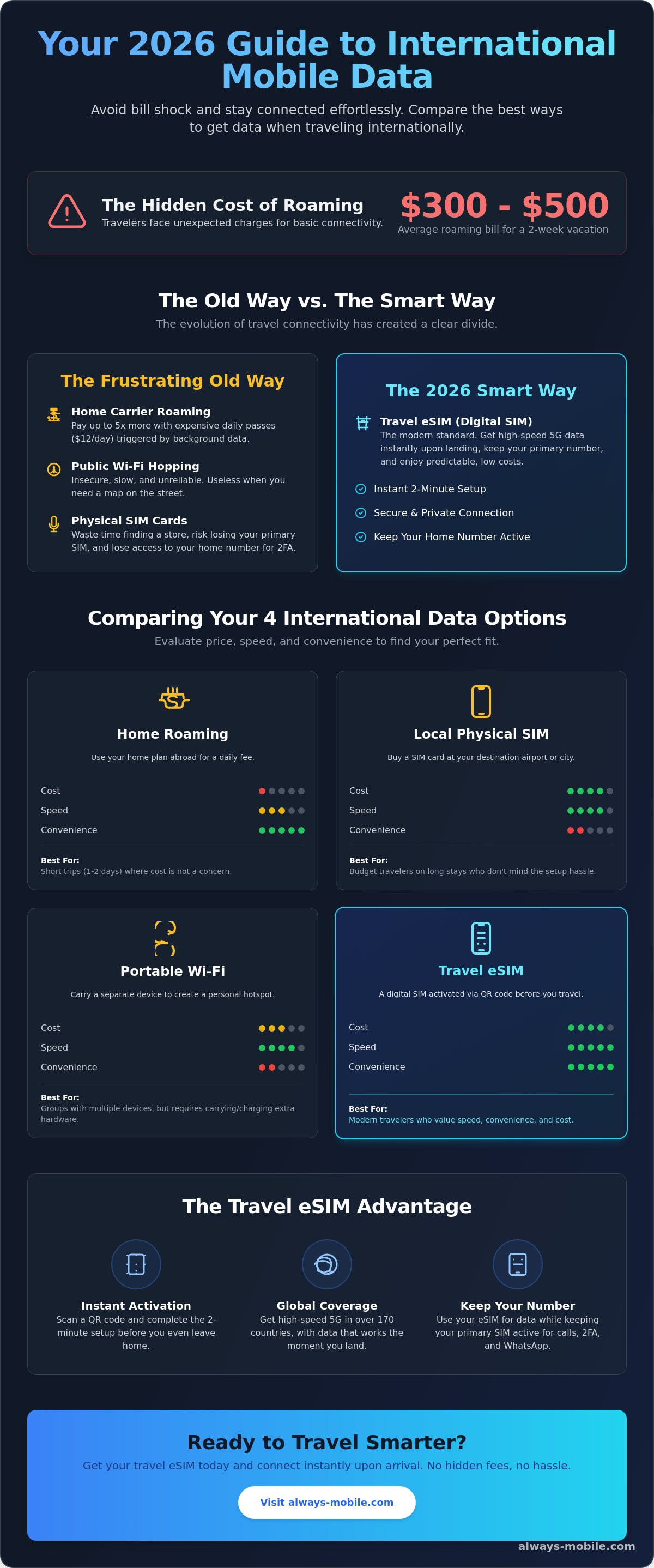
Choosing the best way to get data when traveling internationally depends on your budget and your need for speed. In 2026, four main categories dominate the market. Each has distinct advantages and drawbacks. Start by evaluating how much you value your time versus your wallet. For some, the ease of use justifies a higher price. For others, saving every dollar is the priority.
-
International Roaming: This is the path of least resistance. You do nothing; your home carrier handles everything. It is also the most expensive option. You pay for the convenience of keeping your existing settings, but you often face throttled speeds on host networks.
-
Local Physical SIMs: You buy these at the destination. They are often cheap but require manual intervention. You have to find a store, manage a physical chip, and risk losing your primary SIM card.
-
Travel eSIMs: These are digital-only plans. They offer the best balance of speed, cost, and convenience. They are the modern standard for 2026 travelers.
-
Portable Wi-Fi Hotspots: A separate device that broadcasts a signal. These are useful for families or groups with many tablets and laptops, but they require carrying extra hardware and managing another battery.
The Rise of the Travel eSIM
If you are wondering what is an esim card, think of it as a digital version of the physical chip. It is built into your phone hardware. You don't need to wait for a delivery or visit a physical store. You simply scan a QR code and activate your plan. Most smartphones released in the last five years are fully compatible. This technology allows for instant activation. You can set up your connection while waiting for your flight and have 5G data the second you land. If you need coverage across multiple borders, choosing a global eSIM plan is the most efficient move for seamless border crossings.
Physical SIM Cards: Is the Hassle Still Worth It?
Buying a physical SIM card used to be the gold standard for budget travel. In 2026, the "convenience gap" has widened significantly. The process is tedious. You must find a specific kiosk in a crowded airport terminal. You often have to hand over your passport for a manual scan. Then, you have to swap tiny chips and find a safe place for your home SIM. If you lose that primary card, you lose access to your home number and critical 2FA codes. Modern 5G networks now prioritize digital users for faster provisioning. Physical cards are becoming harder to find and slower to activate. The small savings on data costs rarely justify the security risks and the time lost. When looking for the best way to get data when traveling internationally, the physical SIM is increasingly seen as an outdated relic.
Comparing Price, Speed, and Convenience
Finding the best way to get data when traveling internationally requires a look at the hard data. Price is often the first consideration, but speed and convenience dictate the actual quality of your trip. In 2026, the gap between traditional methods and digital solutions has become impossible to ignore. Efficiency is the new currency for the modern traveler. You need to know exactly what you are paying for and how quickly you can get online.
Analyze the cost-per-GB across your options. Traditional roaming often feels like a utility bill with no cap. You pay for the connection regardless of how much you actually use. In contrast, digital data plans offer a fixed price for a specific amount of data. This predictability eliminates the anxiety of "bill shock" when you return home. Most travelers find that digital plans provide a significant saving, often costing a fraction of what a carrier charges for a daily pass. You get more data for less money, plain and simple.
Time to connect is the next critical metric. Think about the moment you land. If you use a physical SIM, your "time to connect" includes taxiing, clearing customs, finding a kiosk, and waiting in line. This process can easily take 60 to 90 minutes of your first day. With a digital plan, your time to connect is measured in seconds. You toggle a setting in your phone while the plane is still on the runway. You have Google Maps ready before you even reach the arrivals hall.
Carrier Roaming vs. Prepaid eSIM
The math is simple. A major carrier might charge $10 per day for a roaming pass. Over a 10-day trip, that is a $100 expense. A prepaid esim package for the same destination might cost $10 for the entire week. These digital plans offer total transparency. You pay upfront. There are no contracts, no hidden overage fees, and no surprise charges on your next monthly statement. You get exactly what you pay for without any fine print.
Speed and Network Quality Overseas
Network priority matters. In 2026, many "data-only" digital plans receive priority access on local 5G networks. Carriers often throttle roaming users to 4G or even 3G speeds after a small daily high-speed allowance is met. Always check the 5G coverage maps for your destination before you depart. Most major urban hubs across Europe and Asia now offer widespread 5G. A dedicated digital plan ensures you stay on the fastest available band for seamless navigation and video calls. This is often the best way to get data when traveling internationally if you need to work or stream on the go.
Finally, consider number retention. Using a digital data plan allows you to keep your primary SIM active in the background. This is vital for receiving 2FA security codes from your bank or keeping your WhatsApp and iMessage connected to your original number. You get the cheap data of a local plan with the security of your home number, providing immediate relief from technical headaches.
How to Choose the Right Data Plan for Your Trip
The best way to get data when traveling internationally is the one that matches your specific itinerary and usage habits. One size does not fit all. A weekend trip to a single city requires a different strategy than a three-month trek across multiple continents. Start by identifying your traveler profile. Are you a "Weekend Warrior" who only needs Maps and light messaging? Or are you a "Digital Nomad" who requires high-speed 5G for video calls and heavy file uploads?
Calculate your data needs before you commit to a plan. Understanding your consumption prevents you from overpaying for data you won't use or running out in the middle of a navigation route. For context, Google Maps uses approximately 5MB per hour of active navigation. Social media apps like Instagram and TikTok are much heavier, consuming up to 800MB per hour of video scrolling. If you plan to stream music or upload high-resolution photos, your daily usage will be significantly higher than someone who only checks their email.
Every traveler should also have an "Emergency Backup" strategy. Even if you plan to use local Wi-Fi, install a digital data plan before you leave home. It acts as a safety net. If your hotel Wi-Fi fails or you get lost in an area without public hotspots, you can toggle your connection on instantly. This immediate access provides peace of mind and ensures you are never truly stranded.
Single Country vs. Multi-Country Itineraries
If your trip focuses on a deep dive into one nation, local esim plans often provide the best value and highest speeds on local networks. For those planning a tour through Europe or Asia, regional esim plans are the smarter choice. They allow you to cross borders without ever changing your settings or buying new cards. If your journey is truly borderless, a global esim is the ultimate tool for seamless connectivity across 170+ countries.
Unlimited Daily Data vs. Fixed Packages
Fixed packages, such as 5GB for 30 days, are ideal for budget-conscious travelers who use data sparingly. However, power users and remote workers often prefer Daily Unlimited eSIM Plans. Daily Unlimited plans offer a stress-free experience by removing the need to monitor your data consumption constantly. They ensure you stay connected at high speeds regardless of how many videos you watch or calls you take. To simplify your next trip, view our global eSIM options and select the plan that fits your data habits.
Always Mobile: The Smartest Way to Connect in 2026
Always Mobile provides the infrastructure to make your international transition effortless. By eliminating roaming fees in over 170 countries, we remove the primary source of travel anxiety. You no longer have to worry about host carriers or hidden contracts. Instead, you access high-quality local networks directly. This approach bypasses the "tourist tax" often found at airport kiosks. You get the same premium 5G speeds as the locals at a fraction of the cost of a traditional roaming pass. It is the best way to get data when traveling internationally for those who value both their time and their budget.
The 2-minute installation process is designed for speed. You receive a QR code immediately after purchase. Scan it, follow the prompts on your device, and your digital plan is ready. This system removes the friction of traditional travel tech. There are no physical chips to swap and no tiny tools to carry. Choosing a "Data-Only" plan is the secret to these lower prices. By focusing strictly on connectivity, we provide better privacy and lower overhead. You keep your primary number for 2FA and WhatsApp while we handle the heavy lifting of high-speed browsing.
Instant Activation on Arrival
The most efficient workflow is to install your plan at home before you leave for the airport. This ensures you don't need to hunt for a stable Wi-Fi connection upon arrival. Once you land, simply toggle your Always Mobile line to "On" in your cellular settings. You will have 5G data the second the plane wheels touch the tarmac. This immediate connectivity allows you to book an Uber or message your family without a moment of digital isolation. It is a simple, stress-free resolution to the chaos of international arrivals.
Flexible Plans for Every Destination
Whether you need an esim spain for a Mediterranean summer or an esim thailand for a Southeast Asian adventure, our plans adapt to your journey. You are never locked into a long-term commitment. If you find yourself staying longer or using more data than expected, use the digital dashboard to top up your plan in seconds. This flexibility ensures you only pay for what you need. Stop letting your home carrier dictate your travel budget. Get your Always Mobile eSIM and skip the roaming fees today.
Step Into the Future of Travel Connectivity
Travel in 2026 demands immediate, reliable access to the digital world. You've seen how traditional roaming and physical SIM cards fail to meet the needs of the modern explorer. High costs and manual swapping are relics of the past. Transitioning to a digital-first strategy is the smartest move you can make for your next trip. It ensures you have 5G speeds for navigation and social media without the stress of hidden fees.
Always Mobile simplifies this process with instant digital delivery and high-speed local network access. There is no physical SIM swapping required. You maintain your primary number for security while enjoying predictable, low-cost data. This is the best way to get data when traveling internationally in a world that never stops moving. Prepare your connection before you even leave for the airport.
Browse Always Mobile eSIM Plans for 170+ Countries
Enjoy the peace of mind that comes with instant connectivity. Your next adventure is waiting. Stay connected and travel with confidence.
Frequently Asked Questions
Is an eSIM better than a local SIM card for international travel?
An eSIM is generally better because it eliminates the need to visit a physical store or handle tiny hardware. It is the best way to get data when traveling internationally if you value immediate connectivity. You avoid the inflated prices at airport kiosks and keep your home SIM safe inside your device. This digital-first approach ensures you have 5G data the moment you land.
How do I know if my phone is compatible with an eSIM?
Most flagship smartphones released after 2019 support this technology. On an iPhone, go to Settings, then Cellular, and look for "Add eSIM." On Android, check Settings under Connections and SIM Manager. If you see an option to add a plan via a QR code, your device is ready. Ensure your phone is updated to the latest software for the smoothest installation process. Check our Device Compatibility list to see if your device is eSIM-compatible.
Can I keep my WhatsApp number while using a travel eSIM?
You can keep your WhatsApp number exactly as it is. WhatsApp uses your data connection to function but remains linked to your original phone number. When the app detects a new data source, it may ask if you want to change your number. Simply select "Keep" to maintain your existing chats and contacts while using your new digital data plan.
Do I need to turn off data roaming on my primary line?
You must turn off data roaming for your primary home line to avoid unexpected carrier fees. This prevents your home provider from triggering an expensive daily pass the second you connect to a foreign tower. Ensure that data roaming is only enabled for your secondary travel line. This configuration allows you to browse freely while keeping your home line active for incoming emergency texts.
What happens if I run out of data while I am abroad?
You can top up your data instantly through your digital dashboard. There is no need to install a new profile or search for a Wi-Fi hotspot to fix the issue. Simply select the amount of data you need, complete the payment, and the extra GBs are added to your active plan immediately. This keeps your connection seamless without the need for manual intervention.
Are travel eSIMs safe to use for banking and private data?
Digital data plans are significantly safer than using open public Wi-Fi networks in hotels or cafes. They utilize encrypted cellular protocols provided by local 5G and 4G networks. This makes them a secure choice for mobile banking, checking work emails, and managing private travel documents. You get a private, dedicated connection that protects your data from interception on unsecured hotspots.
Can I use an eSIM if my phone is locked to a carrier?
Your phone must be carrier-unlocked to use a third-party travel plan. If your device is still under a payment contract, it might be locked to your home provider. Contact your carrier before your trip to request an unlock. They cannot be used on locked hardware, so verifying this status is a critical step in finding the best way to get data when traveling internationally.
Does an eSIM work for calls and SMS or just data?
These specific plans are data-only to ensure the lowest possible pricing and maximum technical simplicity. You won't have a local phone number for traditional analog calls or SMS. Use data-based apps like WhatsApp, iMessage, FaceTime, or Telegram to stay in touch. This modern approach covers all your communication needs while avoiding the high costs associated with traditional voice roaming.