

Would you pay $2,099 for a single gigabyte of data? If you rely on pay-per-use roaming while traveling, that is exactly what some major carriers charge in 2026. The cost of using phone overseas has become a massive convenience tax that can easily add $500 to $1,000 to your vacation budget. It's a frustrating reality for many travelers who just want to stay connected without decoding carrier jargon or hunting for physical SIM cards in a foreign airport.
You deserve a better way to travel. This guide reveals the hidden fees buried in international roaming plans and offers a clear path to avoiding bill shock. We'll show you how to bypass expensive $12 daily passes and throttled speeds using modern eSIM technology. Discover how to secure reliable 5G data for a fraction of the traditional cost, giving you total peace of mind for your next trip. We'll break down current carrier rates, explain the limits of "Roam Like at Home" regulations, and provide a simple solution for global connectivity.
Key Takeaways
- Identify the hidden reasons why the cost of using phone overseas remains high and how to spot "rental" fees on your bill.
- Learn the technical difference between data roaming and local network access to ensure you always use the most efficient connection.
- Compare the high daily fees of traditional carrier passes with the streamlined value of prepaid Local and Regional eSIM Plans.
- Master the two essential device settings needed to disable expensive home-carrier roaming while maintaining a seamless 5G connection.
- Eliminate the stress of airport kiosks and physical SIM swaps with instant digital activation for your next international trip.
Table of Contents
What is the Actual Cost of Using Your Phone Overseas?
Think of international roaming as a high-priced rental agreement. When you cross a border, your home carrier doesn't have its own towers. Instead, it "rents" space on a foreign network to keep you connected. These inter-carrier agreements are expensive. Carriers add significant profit margins on top of these wholesale costs, which is why the cost of using phone overseas feels so inflated. You aren't just paying for data; you're paying for the convenience of keeping your original SIM active on a network that isn't yours.
In 2026, the technical landscape has changed the way we pay. 5G is now the global standard, and while it's faster, it consumes data at a much higher rate. The three cost pillars remain data usage, outgoing calls, and SMS. However, data is now the primary driver of high bills. High-bandwidth apps for video streaming, cloud syncing, and real-time navigation can drain a traditional roaming allowance in minutes. If your plan isn't optimized for 5G consumption, you're likely paying for a premium service you haven't fully controlled.
The "Bill Shock" Phenomenon: Why It Still Happens
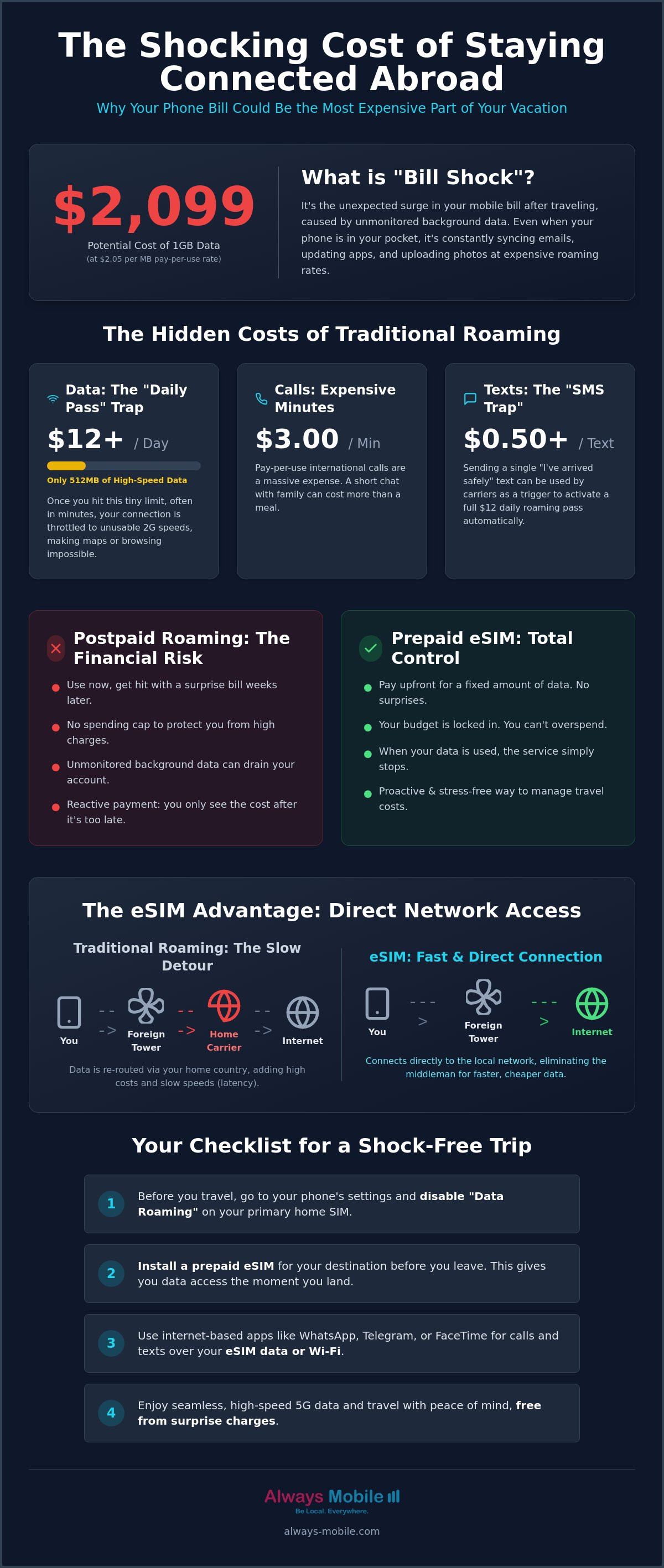
Background app refreshes are the most common cause of massive invoices. Even when your phone is in your pocket, it's constantly syncing emails, updating apps, and uploading photos to the cloud. On a traditional roaming plan, this unmonitored activity is billed at "Pay-as-you-go" rates. Major US carriers often charge $2.05 per MB for this data. At that rate, a single gigabyte would cost you over $2,000. Understanding Data Roaming and how these connections work is vital for your budget. Bill shock is the unexpected surge in mobile costs caused by unmonitored background data.
Postpaid vs. Prepaid Roaming Costs
Traditional postpaid plans are a financial risk. You use the data first and receive the bill weeks later. This "hidden" debt creates a reactive situation where you only realize the cost after the damage is done. There's no built-in ceiling to stop the charges from climbing. 2026 travelers are moving toward "data-only" solutions to regain control. Prepaid models, such as Local eSIM Plans, provide a proactive alternative. You purchase exactly what you need upfront. There are no surprise invoices because the service simply stops when your balance hits zero. This shift toward prepaid data-only plans ensures you never spend a cent more than you intended.
Understanding Data Roaming, Voice, and SMS Charges
There is a major technical difference between data roaming and local network access. When you roam, your home carrier acts as a middleman. They route your data from a foreign tower back to their home servers before sending it to the internet. This detour is why roaming feels sluggish and expensive. Local access via an eSIM skips this process. It connects you directly to the local network as if you were a resident. Switching to a local connection is the most effective way to reduce the cost of using phone overseas because you eliminate the middleman markup.
Traditional voice calls remain a massive expense in 2026. Major carriers like AT&T and Verizon charge between $1.79 and $3.00 per minute for pay-per-use international calls. Even a brief check-in with family can cost more than a local meal. SMS charges are equally deceptive. While receiving a text is usually free, sending one can cost $0.50 or more. Some carriers even use a sent text as a "trigger" to activate a $12 daily roaming pass. This "SMS Trap" can turn a single "I arrived safely" message into a significant daily fee.
The ubiquity of 5G in 2026 has added a new layer of risk. Faster speeds mean your phone can download high-resolution content much faster than in previous years. A 5G connection can burn through a data allowance in a fraction of the time it took on 4G. If you don't manage your settings, your phone might download a system update or sync a photo library in the background at lightning speed, leading to a massive bill before you even leave the airport.
Data Roaming: The Most Expensive Travel Line Item
Don't fall for the "Daily Cap" myth. Many carriers advertise daily passes with "unlimited" data, but the fine print tells a different story. For example, some T-Mobile international passes provide only 512MB of high-speed data. Once you hit that tiny limit, your speed is throttled to 2G levels, making simple tasks like Google Maps nearly impossible. 4K video streaming and social media scrolling are the biggest budget killers. These apps are designed for high-speed 5G and will consume your daily allowance in minutes. Following Practical Ways to Avoid International Roaming Bill Shock will help you stay within your budget.
The Rise of VoIP: Why You Don’t Need Voice Roaming
Traditional voice roaming is now obsolete for the modern traveler. Apps like WhatsApp, FaceTime, and Messenger allow you to make high-definition calls over a data connection. By using a data-only eSIM, you can keep your primary SIM active for receiving essential texts while using local data for all your calls. This setup avoids the $3.00 per minute carrier fees entirely. It's a simple, cost-efficient strategy for digital nomads and vacationers alike. To get started, you can view local data plans that provide the 5G speeds you need without the voice roaming baggage.
Carrier Day Passes vs. Prepaid eSIMs: A Price Comparison
Most major US carriers rely on the "International Day Pass" model. You pay a flat daily rate, usually $12 per day for AT&T or Verizon, to access your domestic plan's data. On the surface, this sounds convenient. In reality, it's a significant contributor to the high cost of using phone overseas. For a standard 14-day vacation, you are looking at $168 in daily fees alone. This doesn't account for taxes or the potential for multiple lines to trigger charges simultaneously. If you're traveling with a family of four, that bill can exceed $600 before you've even paid for a single meal.
Contrast this with a prepaid eSIM model. Instead of paying for 24-hour windows of time, you pay only for the data volume you actually need. If you use 5GB over two weeks, you pay for exactly 5GB. There are no daily triggers and no "convenience" fees. You maintain total control over your budget. This transparency eliminates the anxiety of checking your carrier app every morning to see if you've been billed for another day. You buy your data, use it until it's gone, and top up only if necessary.
The "Multi-Country" problem is where carrier costs truly stack up. If you are hopping between countries in Europe or Asia, some carriers may charge different rates or require separate add-ons for different zones. Regional trips become a logistical and financial headache. Switching to a digital-first solution solves this instantly. One digital profile can cover an entire continent, allowing you to cross borders without changing settings or paying new daily fees. This is the smartest way to manage the cost of using phone overseas during complex itineraries.
The Hidden Limitations of "Unlimited" Carrier Plans
"Unlimited" is often a marketing term rather than a technical reality. Most carriers implement a "Fair Usage Policy" that drastically reduces your speed after a small daily threshold. In 2026, most carrier roaming passes throttle users to 256kbps after just 2GB of daily usage. At 256kbps, your 5G phone becomes nearly useless. You can't load high-resolution maps, stream music, or join a clear video call. You are paying premium prices for 2G-era performance. Prepaid eSIMs provide a more honest experience; you get high-speed 5G for every megabyte you purchase.
Regional and Global eSIM Flexibility
Flexibility is the ultimate cost-saver for the modern traveler. Regional eSIM plans eliminate the need for multiple SIMs when traveling through Europe, Asia, or Latin America. For those on a world tour, Global eSIM plans provide a single solution that works across hundreds of countries. Paying for data volume is logically superior to paying for days. If you spend a full day on hotel Wi-Fi, a carrier still charges you the full daily pass fee. With an eSIM, you spend nothing that day because you didn't consume your data allowance. This efficiency ensures your money goes toward your trip, not your carrier's profit margin.
5 Practical Ways to Avoid International Roaming Bill Shock
Managing the cost of using phone overseas doesn't require technical expertise. It requires a proactive strategy. Most travelers wait until they land to think about connectivity; by then, the carrier fees have already started. Follow these five steps to lock in your budget and ensure your 5G connection remains affordable throughout your trip.
-
Step 1: Switch to a prepaid travel eSIM before you depart. Purchase your plan while you are still at home. This allows you to install the digital profile and hit the ground running the moment your plane touches the tarmac.
-
Step 2: Disable "Data Roaming" on your primary SIM card immediately. This is the most critical step. Go into your settings and ensure your home SIM is restricted from using data. This prevents your carrier from triggering a daily pass the second you receive a background notification.
-
Step 3: Use "Low Data Mode" on your device. Both iPhone and Android offer this setting. It restricts background syncing, pauses automatic photo backups, and stops app updates. It's a simple way to make your data allowance last significantly longer.
-
Step 4: Download offline maps and media. Use your home or hotel Wi-Fi to download Google Maps areas, Spotify playlists, and Netflix shows. This reduces your reliance on a live connection for basic navigation and entertainment.
-
Step 5: Monitor your usage in real-time. Use your eSIM provider app or portal to track exactly how many megabytes you have left. Visibility is the best defense against unexpected costs.
Configuring Your Dual-SIM Settings
Modern smartphones allow you to keep two lines active at once. Set your eSIM as the "Primary Data" source while keeping your home line active for "Voice and SMS" only. This configuration allows you to receive essential 2FA texts for banking without using expensive roaming data. You must turn "Allow Cellular Data Switching" OFF. If this remains on, your phone might automatically switch back to your expensive home carrier if the local signal dips. Airplane Mode is a useful tool, but it's often too restrictive; it cuts off your 5G data entirely. Proper Dual-SIM management is a much smarter alternative for the 2026 traveler.
Leveraging Wi-Fi and Offline Tools
Public Wi-Fi in 2026 presents significant security risks, especially in high-traffic tourist areas. Use your personal eSIM data connection for sensitive tasks like banking or work emails. It is much safer than an open airport network. If you have a heavy work day planned, consider using Daily Unlimited eSIM Plans to avoid worrying about caps. Set your photo library to sync only when you are connected to power and a trusted Wi-Fi network. This prevents your phone from trying to upload 4K videos over your travel data. Secure your connection before you fly by choosing one of our prepaid eSIM plans today.
Why Always Mobile is the Smartest Way to Stay Connected
Choosing the right provider is the final step in mastering the cost of using phone overseas. Traditional carriers rely on your desire for convenience to justify high margins. Always Mobile flips this model. We provide a digital-first solution that prioritizes speed, transparency, and local network quality. You no longer need to wait for a physical SIM card in the mail or stand in long lines at airport kiosks. Our system is built for the modern traveler who values time as much as their budget.
Transparency is the core of our service. You will never encounter hidden fees, complex contracts, or surprise bills when you return home. You pay for your data upfront, and that is the end of the transaction. We provide direct access to high-quality 4G and 5G networks in over 170 countries. Whether you need local country plans for a short city break or daily unlimited options for a data-heavy business trip, our offerings are designed to fit your specific itinerary.
The Always Mobile Advantage: Simplicity and Speed
Setup is a streamlined three-minute process. Buy your plan. Scan the QR code. Connect to the local network. This immediate activation ensures you have 5G data the moment you land. Our data-only model is also the most secure way to travel in 2026. It keeps your primary home number isolated from foreign data networks, reducing the risk of accidental roaming triggers. If you ever run into a technical hurdle, our support team understands the nuances of international hardware and network bands. We focus on utility so you can focus on your journey.
Ready for Your Next Adventure?
The cost of using phone overseas doesn't have to be a source of stress. By switching from carrier roaming to a prepaid eSIM, you can save hundreds of dollars on a single trip. Stop paying the "convenience tax" to your home provider for sub-par, throttled speeds. Take control of your connectivity and enjoy the peace of mind that comes with a fixed-cost data plan. Check your destination today and lock in your high-speed access before you head to the airport. Find the perfect data plan for your next trip and experience the relief of a bill-shock-free vacation.
Secure Your Global Connection Today
The era of receiving a four-figure mobile bill after a vacation is over. You now have the technical tools to bypass expensive carrier markups and daily convenience taxes. By adopting a digital-first strategy, you gain transparency and total control over your spending. Managing the cost of using phone overseas is now as simple as installing a digital profile before you board your flight and adjusting a few basic settings on your device.
Always Mobile offers instant 5G connectivity in 170+ countries. There are no contracts and no hidden roaming fees to worry about. We are trusted by thousands of global travelers who demand reliability without the administrative headache of traditional carriers. Whether you choose our Local or Global eSIM Plans, you'll experience a seamless connection from the moment you land.
Don't wait until you see an expensive roaming charge to make the switch. Stop overpaying for roaming—get your Always Mobile eSIM today. Enjoy your next adventure with the peace of mind that you're always connected and never overcharged.
Frequently Asked Questions
Is it cheaper to buy a local SIM card or use an eSIM?
eSIMs are generally the superior choice for modern travelers. While local physical SIMs were once slightly cheaper, 2026 digital rates are now highly competitive. You avoid the hassle of finding a physical store, dealing with language barriers, and the risk of losing your home SIM card. You get the same local network quality with instant activation.
Will I be charged for receiving text messages while overseas?
Most carriers do not charge for receiving standard SMS messages while abroad. However, you must be careful. If your home SIM is active, receiving a text might not cost anything, but sending one or allowing a background app to use a tiny bit of data could trigger a $12 daily roaming fee. Keep your home line for 2FA only and use your eSIM for all data.
How do I stop my phone from using data abroad without my knowledge?
Disable "Data Roaming" on your primary SIM card and turn off "Cellular Data Switching" in your settings. These two steps are the most effective way to control the cost of using phone overseas. Additionally, enable "Low Data Mode" to restrict background app refreshes and automatic cloud backups that happen without you noticing.
Can I keep my WhatsApp number if I use a travel eSIM?
Yes, you can keep your existing WhatsApp number and all your chat history. WhatsApp identifies your account by your original phone number, not the data connection you are currently using. When you install your new eSIM, the app might ask if you want to update your number. Simply select "No" or "Keep" to continue using your account as usual.
What happens if I run out of data on my Always Mobile plan?
Your data connection will simply pause. There are no hidden overage charges or surprise bills. For our Fixed-Data eSIM plans, you can top up your existing eSIM profile instantly. This gives you total control over your budget and ensures you only pay for the high-speed data you actually consume during your trip. Our Daily Unlimited eSIM plans cannot be topped-up.
Do I need to unlock my phone to use an international eSIM?
Yes, your device must be carrier-unlocked to use any eSIM from a third-party provider. Phones purchased on payment plans are often locked until the balance is paid in full. Check your device settings under "About" or "Carrier Lock" to confirm your status. If your phone is locked, you must contact your carrier to request an unlock before you depart.
How much data does Google Maps use while traveling?
Active navigation typically uses between 5MB and 20MB of data per hour. This varies depending on whether you are using satellite view or real-time traffic updates. To minimize data consumption, download your destination's map area for offline use while you are on Wi-Fi. This allows you to navigate via GPS without using any of your prepaid data allowance.
Is 5G roaming available in most countries in 2026?
5G is the standard for international roaming in most developed nations in 2026. You can expect high-speed connectivity in most major cities and tourist destinations. While 5G provides a faster experience, it can also lead to quicker data consumption for background tasks. Monitoring your usage is the best way to keep the cost of using phone overseas predictable and affordable. Check our product pages to see what speeds (5G or 4G/LTE) are available at your destination.